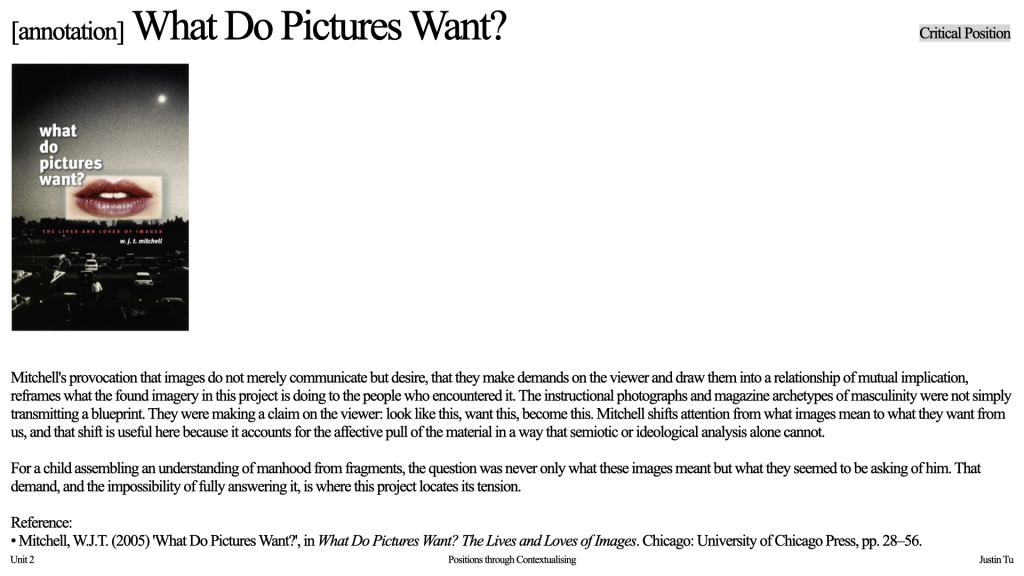
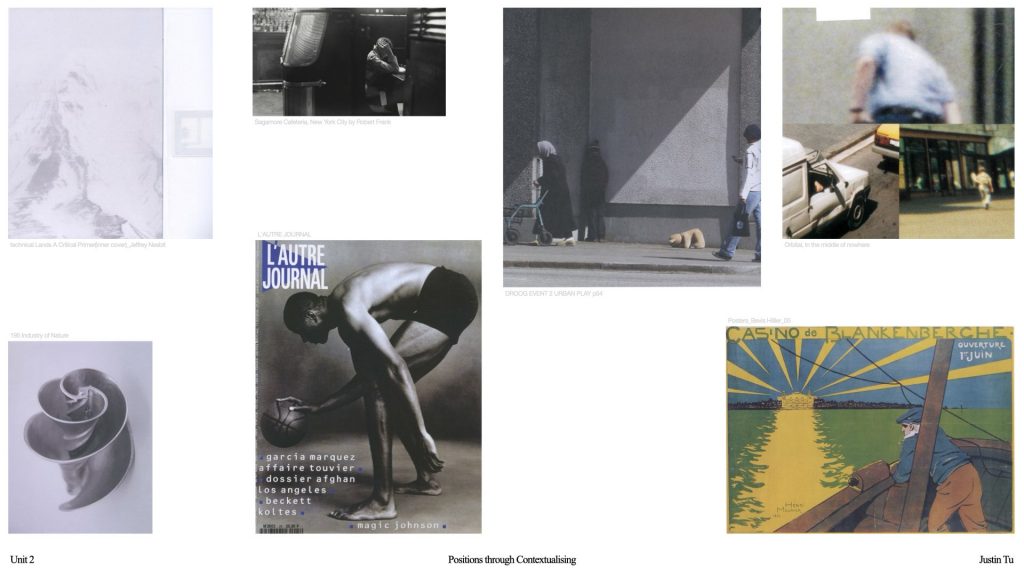
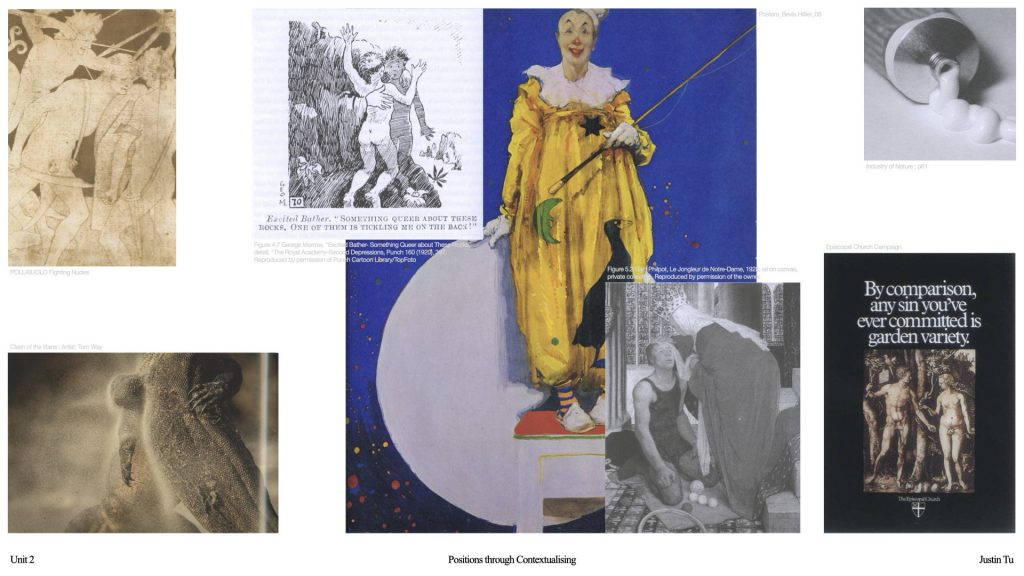
Framing changes meaning. The same image, placed under different frames, produces different readings, and the heavier the frame’s symbolic weight, the more obvious the shift.
Take the flag: the same image reads as unity to one viewer, threat to another. That weight has been embedded so deeply, through history, through repetition, through power, that it feels self evident. What surrounds an image reshapes the image itself.
The question begins with the frame, everything placed around an image to tell it what to mean. But a frame is a kind of instruction, and instructions have limits.
So what happens when the instruction disappears? When there is no border at all, only image against image, and meaning has to be built in the space between them?
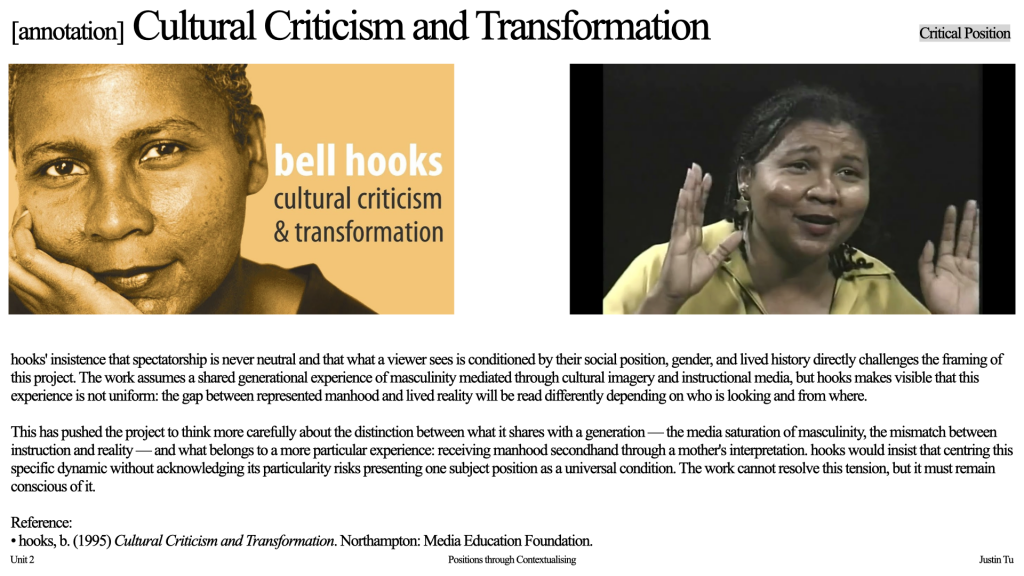
Because this is not only how we read pictures. It is how a person is built. For bell hooks, popular culture is where the learning happens, where so much of who we become is taught. The images around us were never neutral. They shaped us.
II. Reading MANHOOD
And nothing shapes how we read manhood more than who first showed it to us. Usually, that is the father. But for many of us, a generation raised on the absent provider, he was not fully there.
Not gone, but distant. Present as a provider, rarely as a presence.
The primary male figure in these lives was also the one they knew least. So the picture of manhood came from elsewhere. From their mothers, less a picture of the actual father than a picture of what a man should be, shaped by her own desire and her own disappointments. From mass media, which filled the gaps with its own projections. Between them, a standard a man could never quite meet.
The man built in the mind never quite matched the man who was there.
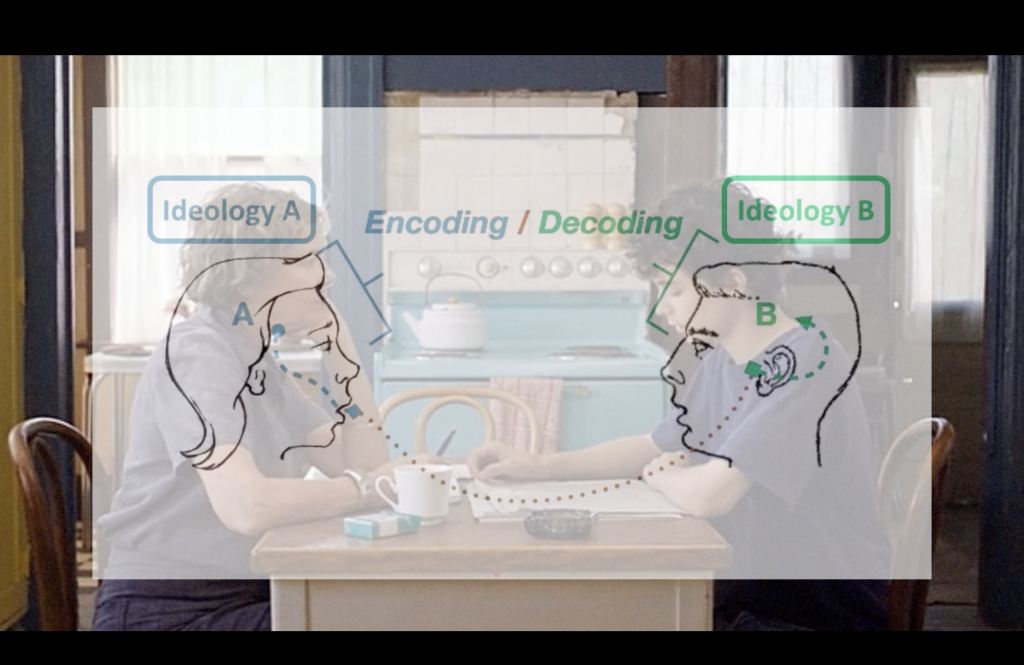
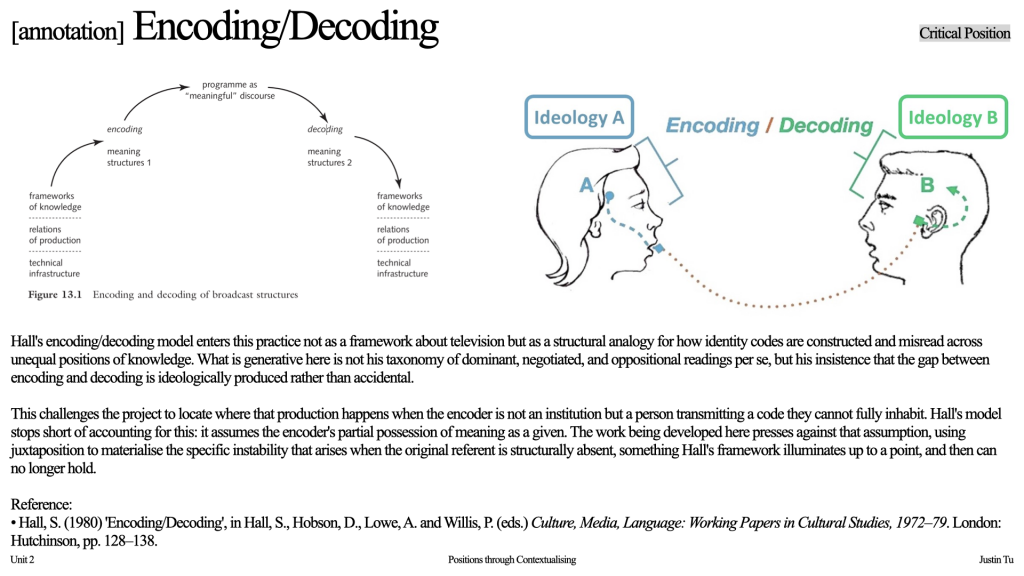
Stuart Hall gave us a way to describe this. Meaning, he argued, is never simply passed from sender to receiver. A message is encoded by someone, shaped by their position, and then decoded by someone else, from theirs. Meaning lives in the gap between.
Here, the message was manhood itself. Encoded by a mother, a woman translating a gender she did not inhabit. And decoded by a child, too young to read it, with no original to check it against.
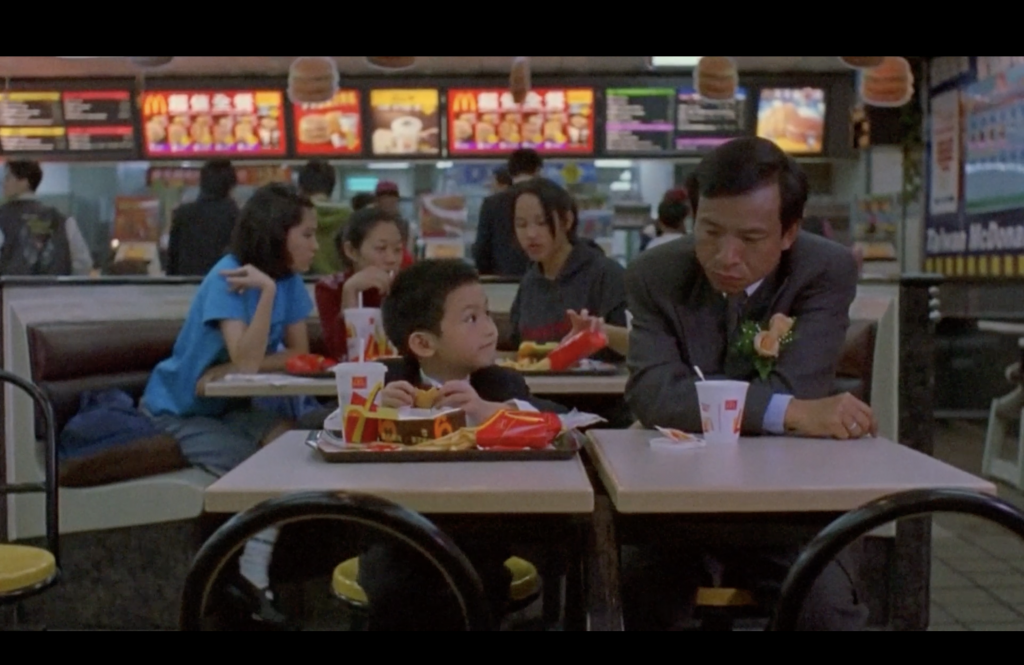
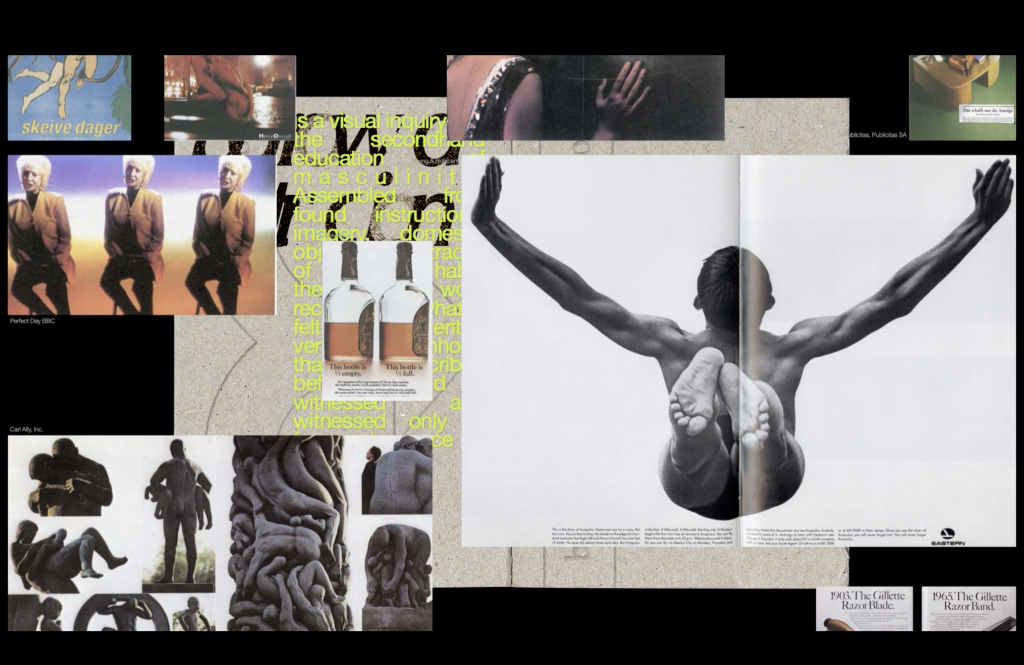
So the search began. For the missing image, in the places that seemed to hold it. In books. In magazines. In films. In a mother’s words, gathered up and assembled into a man. Fragments collected and held against each other, looking for a shape, piecing together a picture of what a boy was supposed to become.
It was happening without anyone knowing. We were reading before we knew we were reading. Image placed beside image. Meaning built in the space between.
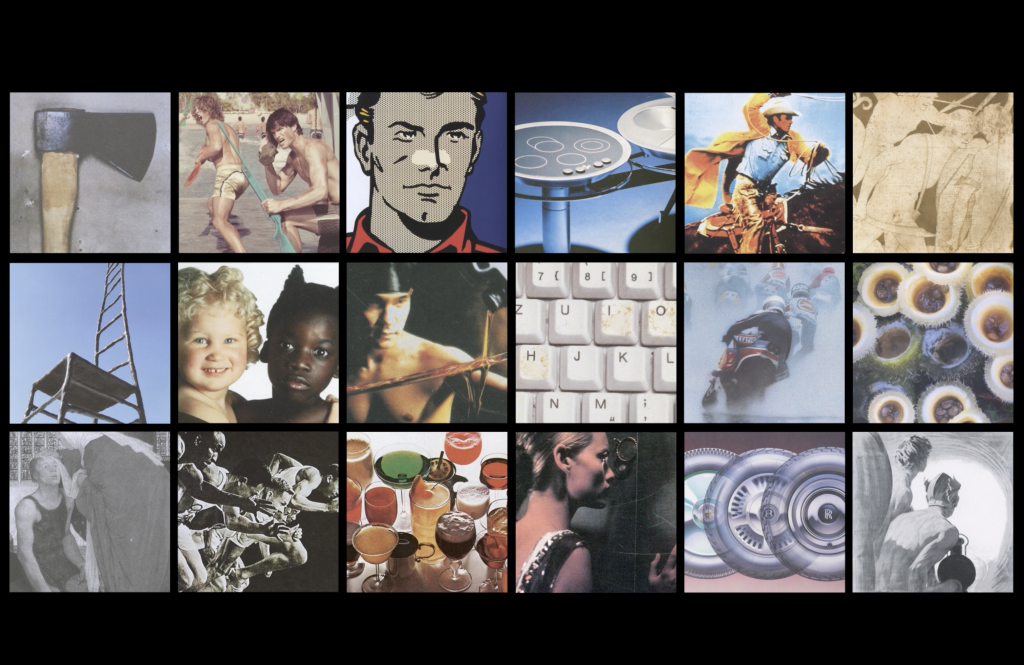
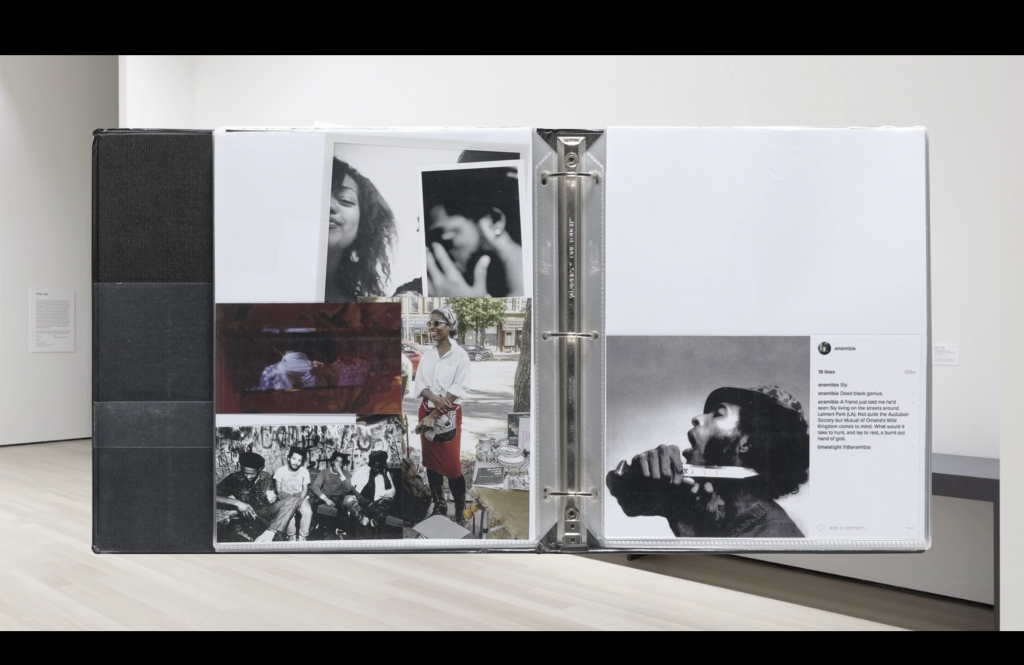
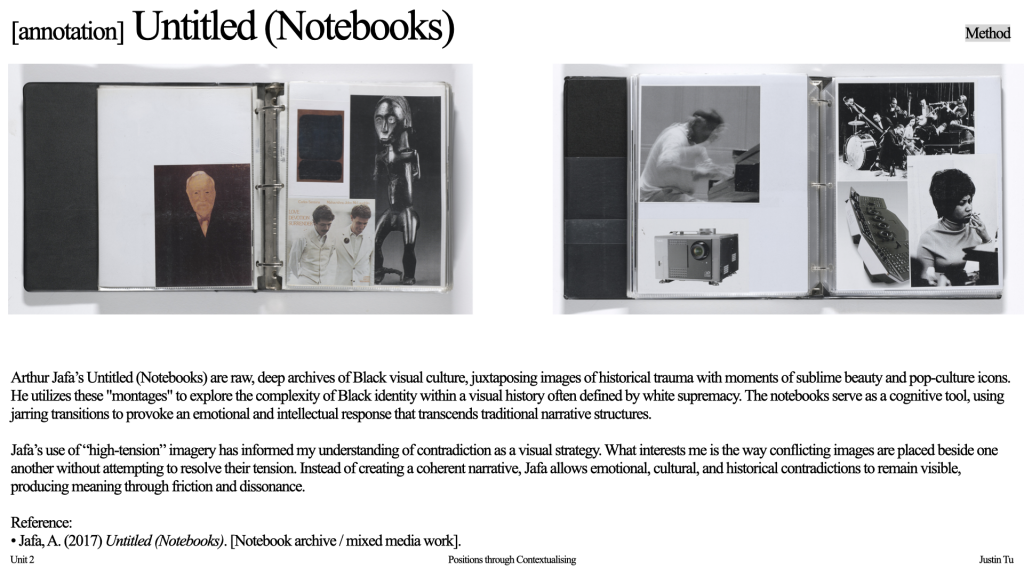
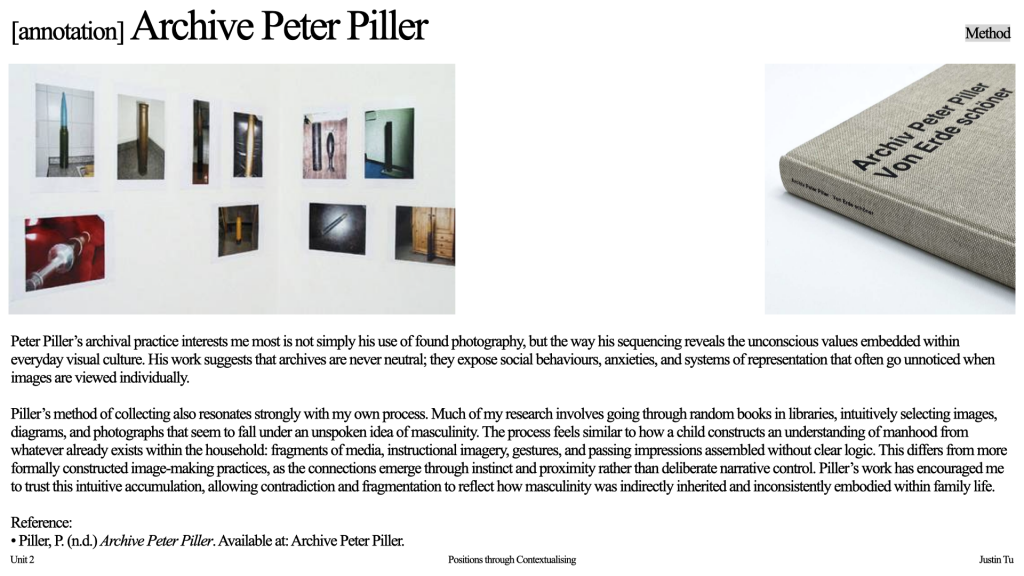
Arthur Jafa worked this way on purpose. His notebooks gather clippings from magazines, newspapers, and advertisements, juxtaposed across decades to hold the contradictions of Black life in view. He lets the images speak against each other. He does not resolve them.
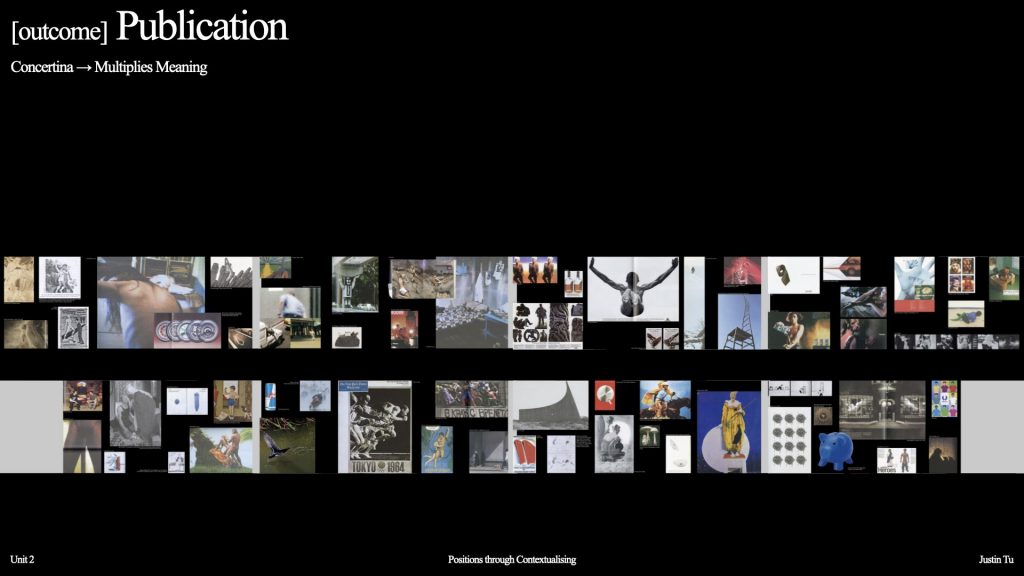
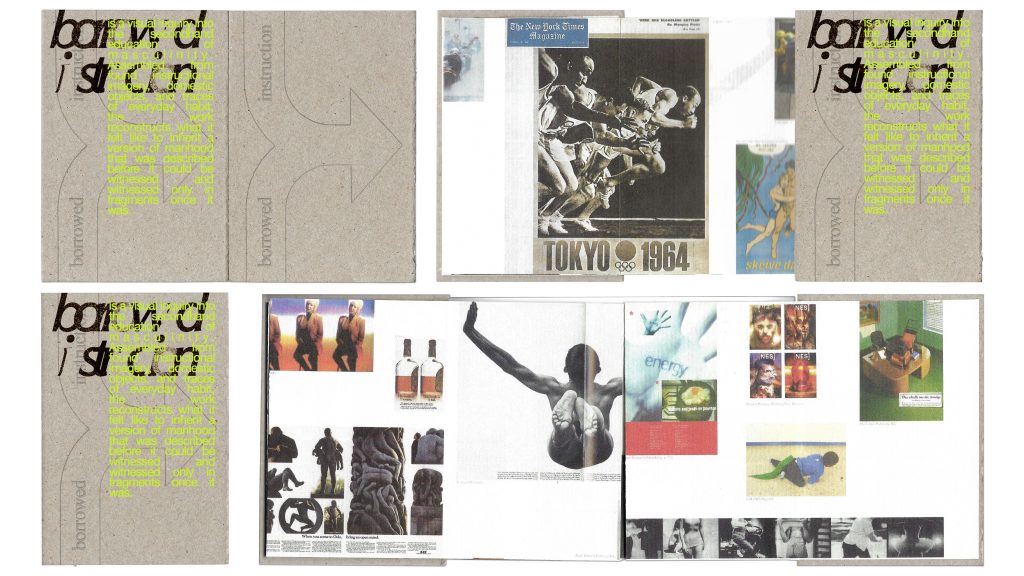
This is what Borrowed Instruction does, for a different question: how a son assembles a picture of a man. It takes those fragments, the borrowed pictures, the secondhand instructions, and places them back into dialogue. Image against image, with no caption, no father to fix their meaning, only the source, which fixes nothing. It does not resolve them. It lets the gap stay visible.
What once happened to us without our knowing, we now do on purpose. This time, we choose how to read them. Because that gap was never empty. It was where we did the building all along.
Footage: •20th Century Women (Mike Mills, 2016) •The Pagemaster (Maurice Hunt, 1994) •Yi Yi: A One and a Two (Edward Yang, 2000)
References: •Hall, S. (1980) ‘Encoding/decoding’, in Hall, S., Hobson, D., Lowe, A. and Willis, P. (eds.) Culture, Media, Language: Working Papers in Cultural Studies, 1972–79. London: Hutchinson, pp. 128–138. •hooks, b. (1997) Cultural Criticism & Transformation. Directed by S. Jhally. [Film]. Northampton, MA: Media Education Foundation. •Jafa, A. (1990–2007) Untitled notebook (object no. 1131.2018). [Artwork]. New York: Museum of Modern Art.
Stuart Hall’s Encoding/Decoding (1980) challenges the assumption that communication transmits meaning transparently from sender to receiver. Hall argues that media texts are encoded with preferred meanings shaped by dominant cultural and ideological frameworks, but that audiences decode these messages through their own social positions, producing dominant, negotiated, or oppositional readings. Meaning, for Hall, is never fixed but always contested in the gap between encoding and decoding.
This framework becomes unexpectedly generative when applied beyond broadcast media to more intimate circuits of transmission. In my own practice, the “text” being encoded and decoded is not a television programme but masculinity itself, a set of codes, behaviours, and expectations passed from mother to child in the absence of a father. Here the encoder is not a media institution but a woman translating a gender she does not inhabit, shaping a preferred meaning of manhood from the outside. The decoder, the child, receives this transmission and negotiates it not against institutional ideology but against the lived reality of who is actually present, who is actually looked up to. The result is neither a clean dominant reading nor a straightforwardly oppositional one: it is a negotiated, approximate, and deeply personal decoding of what it means to be a man, assembled from instructions that were always secondhand.
Hall’s model, even in its most nuanced form, depends on one underlying assumption: that the encoder possesses, at least partially, the code they are transmitting. Institutional authority derives from this possession, the broadcaster knows the preferred meaning of the national interest, even if the audience resists it. But in the circuit this project describes, that possession is structurally impossible. The original referent, the father, masculinity as directly inhabited experience, is absent from both ends of the transmission. The encoder cannot possess what was never fully present to her. The decoder cannot verify what he receives against any original. There is no source to return to. This is not a failure of communication in Hall’s sense, not a misalignment between meaning structures 1 and 2 that could in principle be corrected. It is a condition in which the original encoding never existed in a stable form. What circulates instead is a construction that presents itself as a transmission, a preferred meaning of masculinity assembled from approximation, desire, and absence, passed on with the confidence of someone who believes they are relaying something real. The distortion is not in the gap between sender and receiver. It is built into the message from the beginning.
Formally, this theoretical understanding shapes the logic of juxtaposition in the work. The project places found imagery from magazines and instructional print media, confident and authoritative encodings of what a man should look like, how he should behave, what he should provide alongside images drawn from the domestic and the habitual: objects, gestures, and traces of the life that was actually being lived. These are not paired as simple opposites, false masculinity against real warmth. The pairings are more uncomfortable than that. They recreate the condition of receiving a fractured transmission: the official instruction sitting next to quiet evidence that the life surrounding it told a different story.
This is the experience Hall’s framework describes but cannot fully recreate analytically. The gap between meaning structures 1 and 2, between what was encoded and what was decoded, becomes something the viewer stands inside rather than reads about. The juxtaposition does not illustrate a contradictory transmission. It enacts one. The viewer feels the instability before they can name it, which is precisely the condition of a child assembling identity from instructions that were never internally consistent to begin with.
[critical analysis]
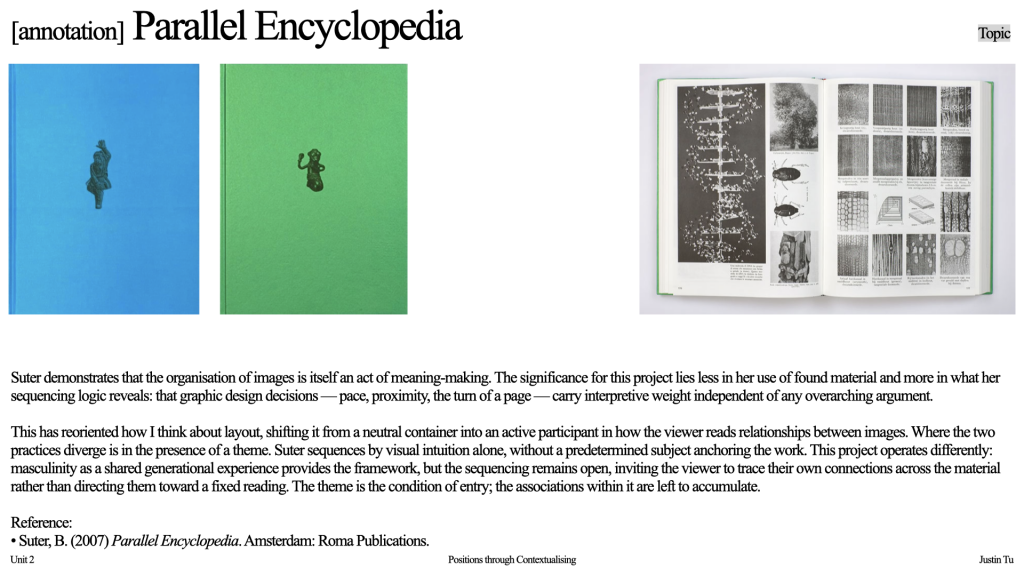
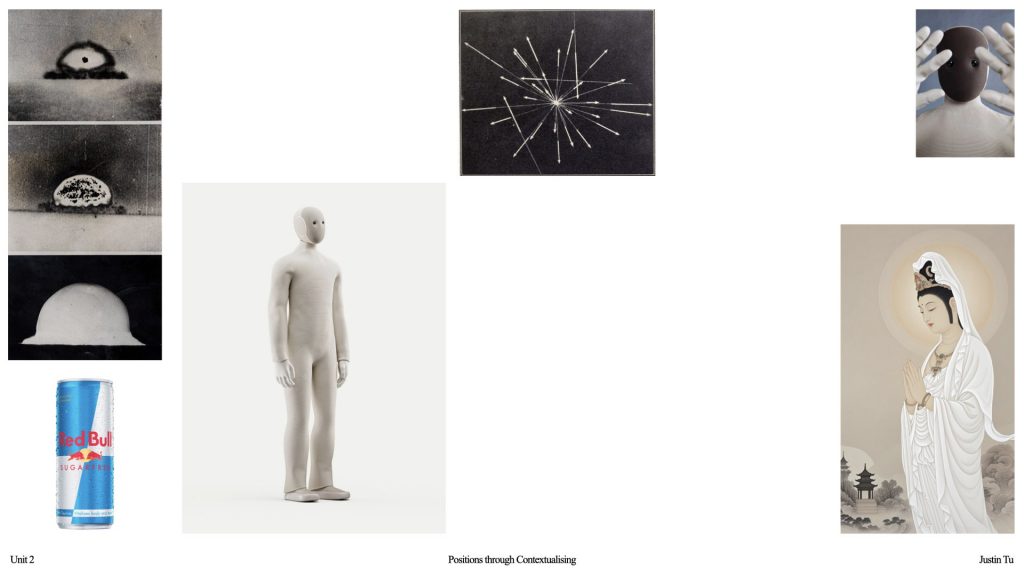
Batia Suter’s Parallel Encyclopedia (2007) is an artist’s book composed of found images sourced from vintage encyclopedias, spanning subjects such as science, nature, anatomy, and architecture. Removed from their original captions and reordered into a non-linear sequence, the images form unexpected visual associations that disrupt their initial classificatory function. Through juxtaposition and sequencing, Suter collapses distinctions between disciplinary categories, encouraging viewers to read images through resemblance, rhythm, and visual intuition rather than through scientific taxonomy. The absence of explanatory text destabilises the authority typically associated with encyclopedic systems of knowledge, transforming the publication from a didactic reference tool into an open-ended visual field.
The formal qualities of the book are central to this process. The sequencing of full-page images across spreads creates connections between otherwise unrelated subjects, allowing meaning to emerge relationally rather than hierarchically. For example, microscopic organic forms may visually echo architectural structures or mechanical systems, producing associations that blur boundaries between the natural and constructed world. In this sense, Suter uses editorial design not to clarify information, but to complicate and destabilise it. The work challenges the conventional role of graphic and communication design as a tool for order, legibility, and categorisation, rather than functioning as a neutral support system for pre-existing information, graphic design in Parallel Encyclopedia becomes a generative mechanism through which meaning is actively produced.
Although Suter’s process appears intuitive rather than overtly political, the work implicitly critiques encyclopedic authority by dismantling systems of classification and linear organisation. However, the project’s emphasis on visual openness also reveals certain limitations. While Parallel Encyclopedia encourages associative interpretation, Stuart Hall’s theory of encoding and decoding suggests that viewers never approach images from neutral positions; meaning is always shaped through culturally situated processes of interpretation. bell hooks extends this critique by arguing that spectatorship is further structured by power relations, particularly through race, gender, and histories of representation. Together, these perspectives complicate the apparent openness of Suter’s work, revealing that visual interpretation is never entirely free from ideology or social conditioning.
This tension between openness and conditioned spectatorship is particularly relevant to my own project. While I am interested in Suter’s use of archival imagery, fragmentation, and associative sequencing, I also want to critically examine how meaning is shaped by culturally embedded assumptions and structures of power. Rather than treating interpretation as unlimited, my project explores how viewers project ideological and emotional frameworks onto visual material. In this way, Suter’s work has influenced my understanding of graphic design not simply as a neutral system of communication, but as a medium that actively constructs relationships between knowledge, perception, and interpretation.
Starting this brief I decided to drop the framing devices as it is quite limiting and in some ways disrupting to my exploration on the dialogic interaction between imagery(symbols).
So I changed the enquiry line to:
I am trying to explore graphic design as a system of “cognitive intervention” that exposes biased perception.
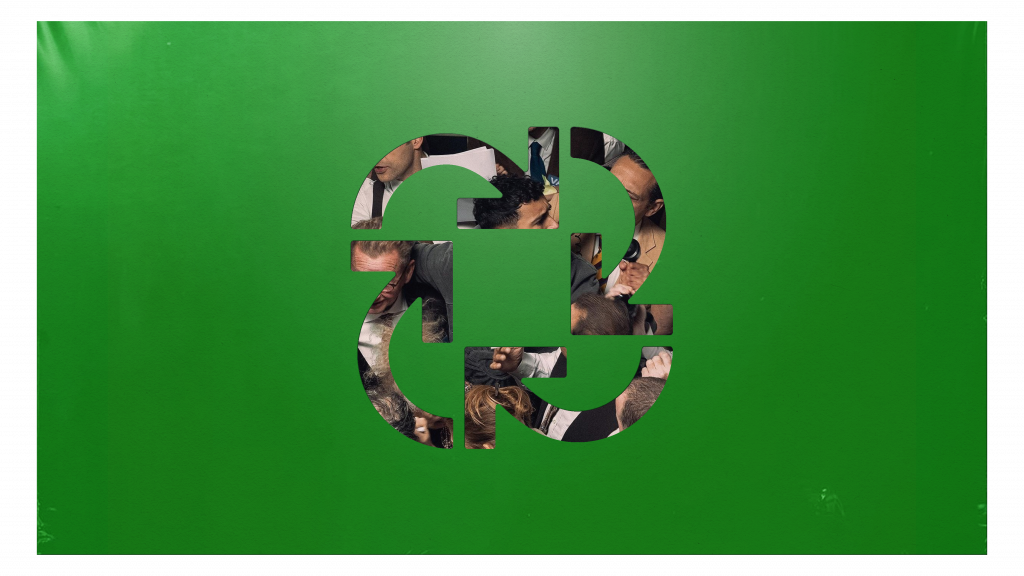
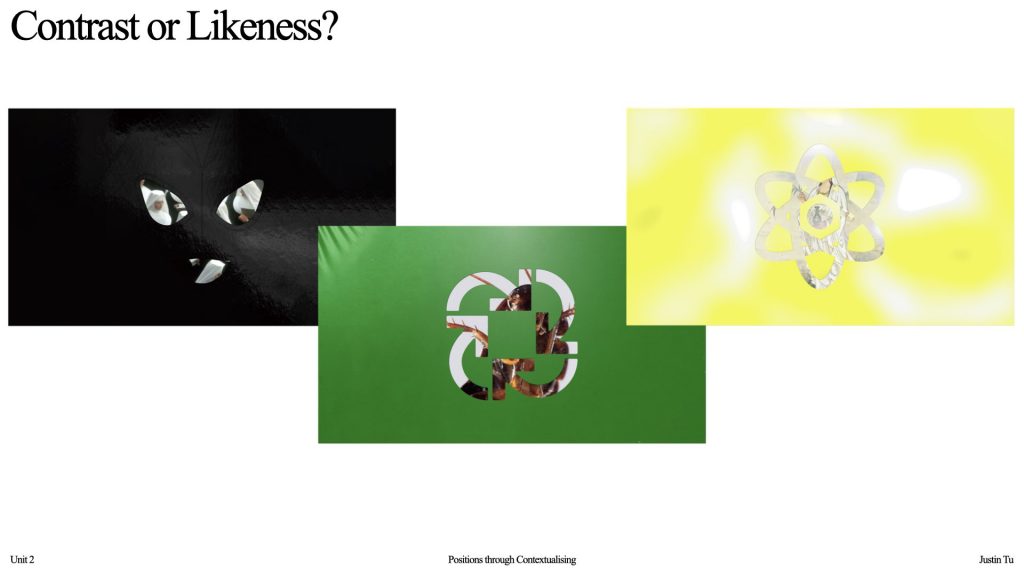
Although I have dropped the framing devices, these 3 from the previous set of iterations drew my attention.
At the beginning of the project, I was experimenting quite intuitively — pairing different symbols with contrasting imagery to see how they interact. For example, placing something that feels clean or structured with something more nasty or chaotic, to create a kind of visual tension between what we usually think of as good and bad.
Take the cockroach, for example. My initial instinct was to frame it as something undesirable, something we want to eliminate. But actually, cockroaches are incredibly resilient. They’ve survived for millions of years, and now they’re even being studied for their potential role in breaking down waste, including plastic. So instead of being purely negative, they can also represent sustainability and adaptation.
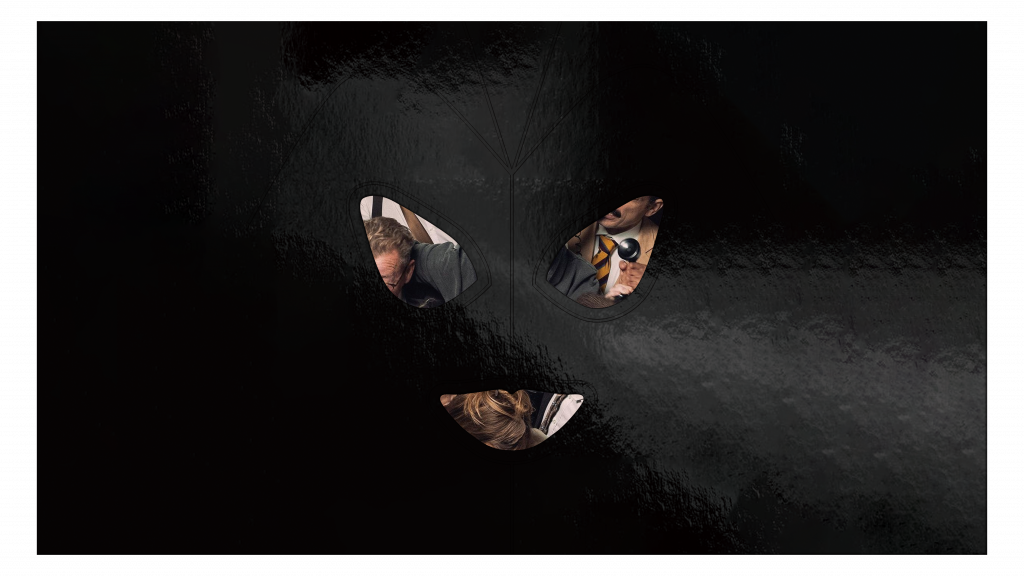
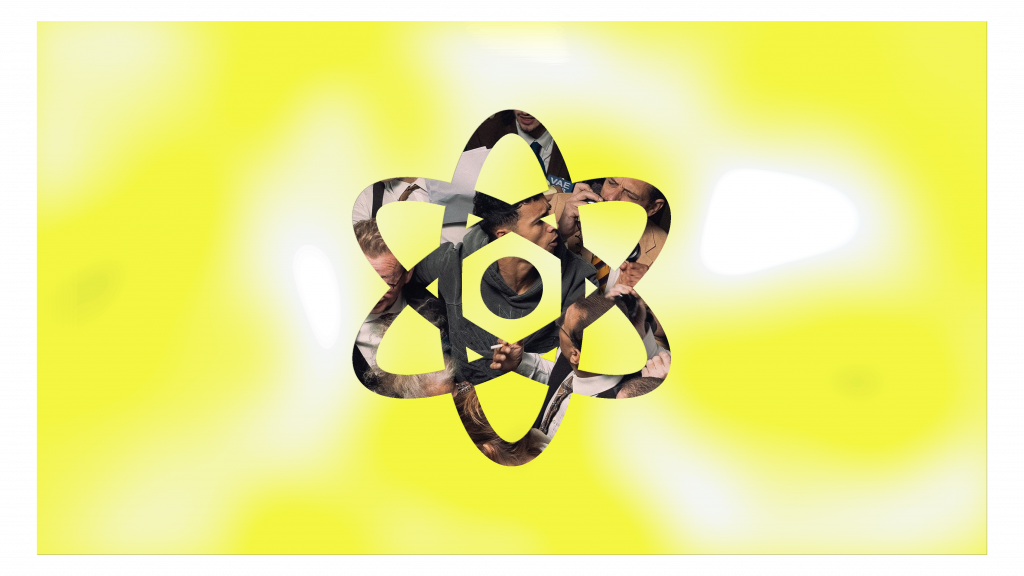
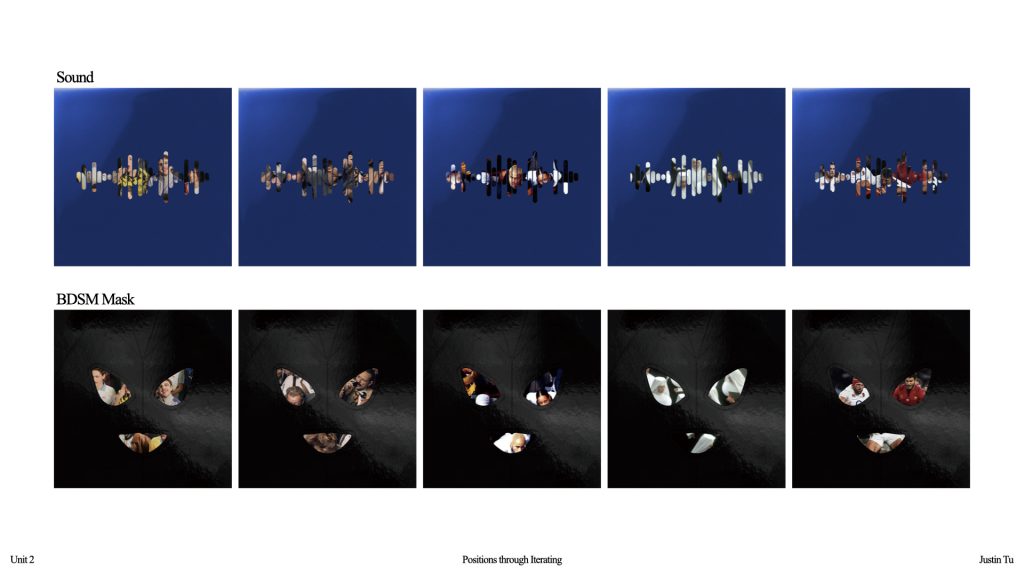
That shift made me look again at the other pairings, like Guanyin and nuclear energy, or the nun and BDSM mask. At first glance, these feel like opposites, even contradictions. But the more I think about them, the more I feel they share a similar underlying energy.
They’re all tied to ideas of control, belief systems, discipline, and transformation, just expressed through very different cultural, temporal, or moral frameworks.
So what I’m interested in exploring now is how our cognitive lens categorizes things too quickly. We label things as sacred or dangerous, but those boundaries are often constructed. Underneath, there can be shared meanings that just manifest differently depending on context and time.
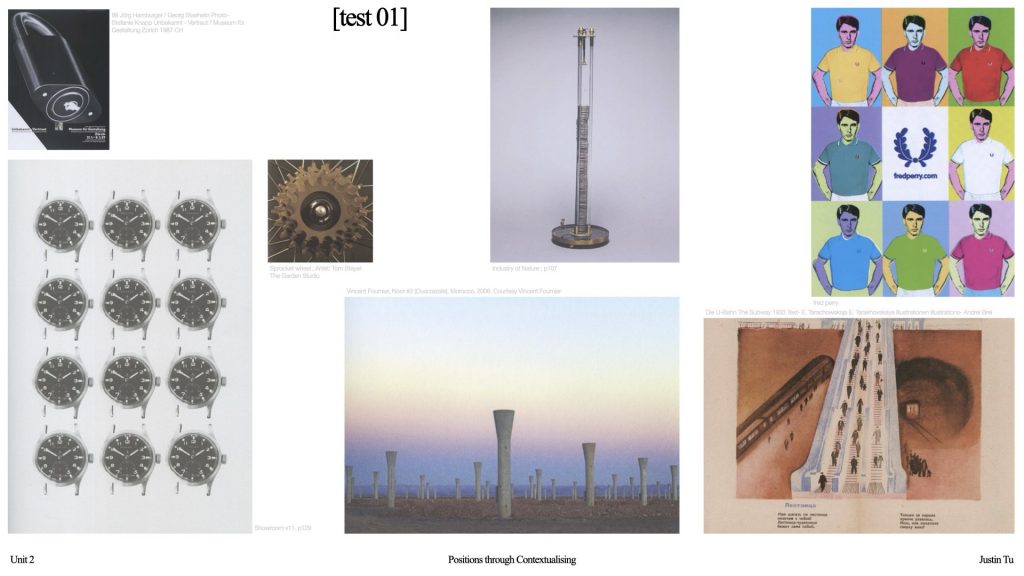
[test01] Shared Meaning: Energy
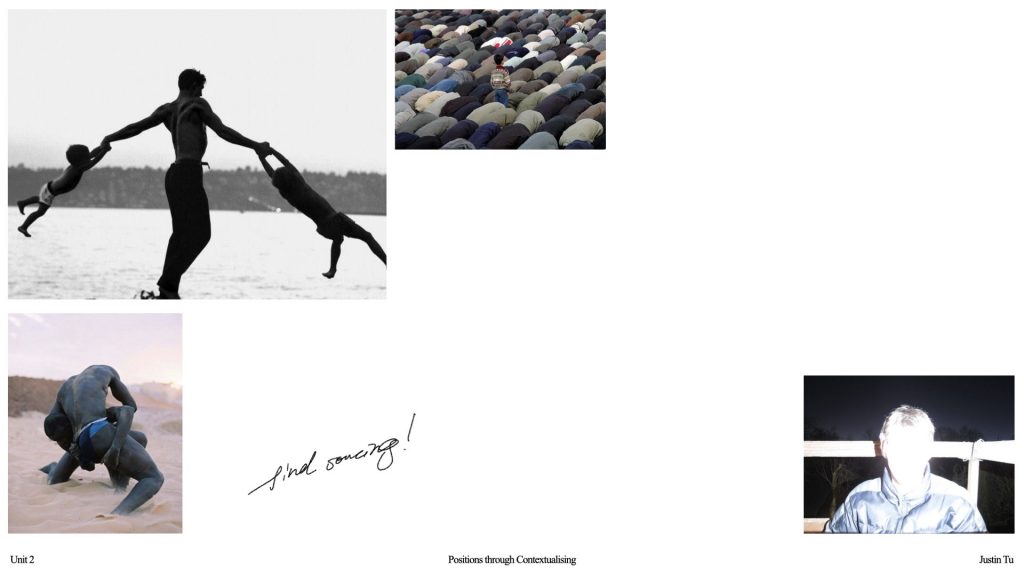
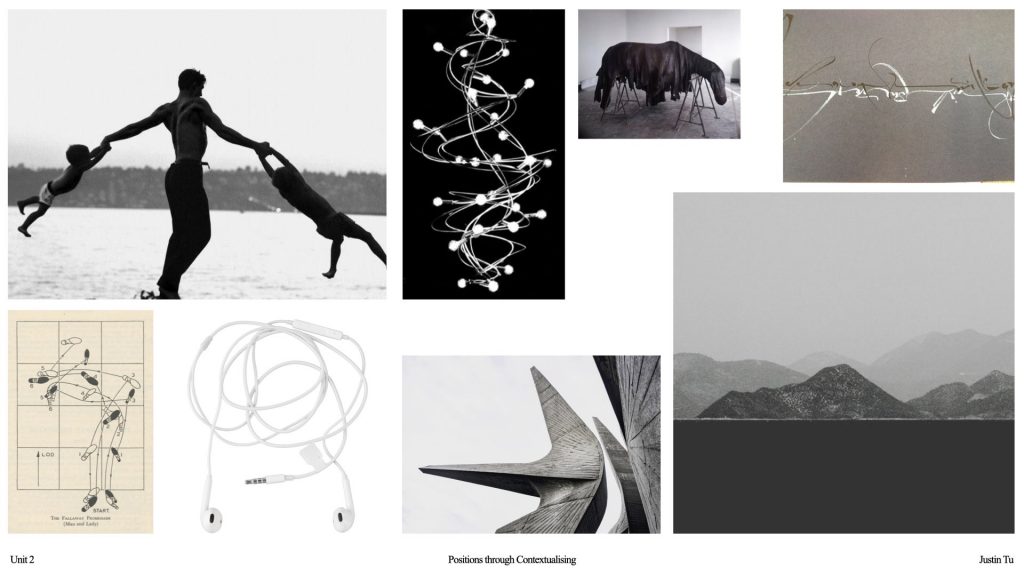
From [test01], I began thinking about alternative ways to connect imagery together, using Jacques d’Amboise Playing with His Children, Seattle, 1962 by John Dominis as a reference point.
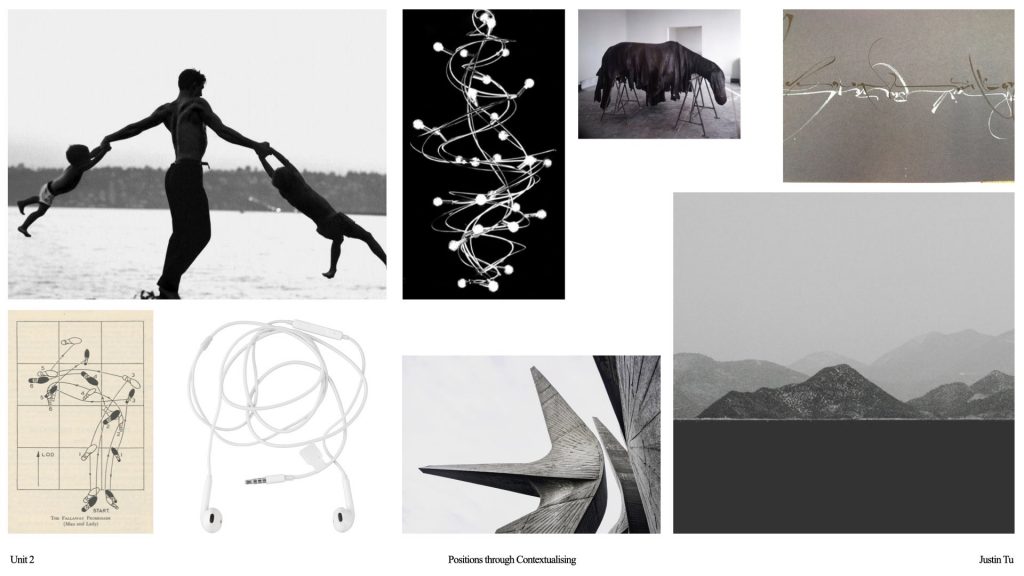
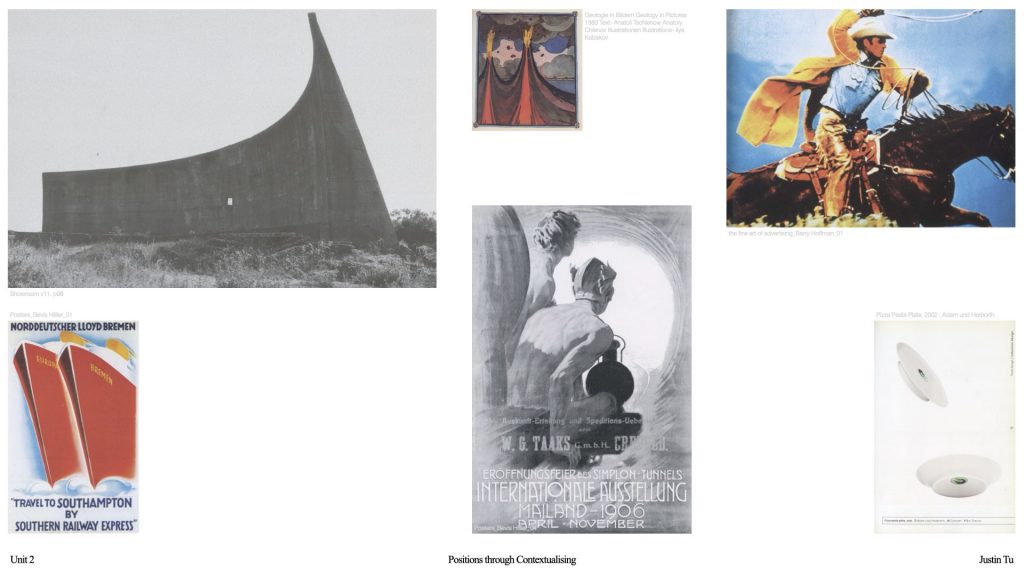
In Parallel Encyclopedia (2007/2016), Batia Suter employs a method of visual sequencing based on rigorous formal resonances, linking disparate images across history and discipline by matching their shapes, surfaces, textures, and lines. She arranges these decontextualized elements to reveal unexpected structural homologies, moving away from thematic or narrative sorting to investigate how pure visual morphology can bridge entirely unrelated subjects.
[test02] Formal Resonances
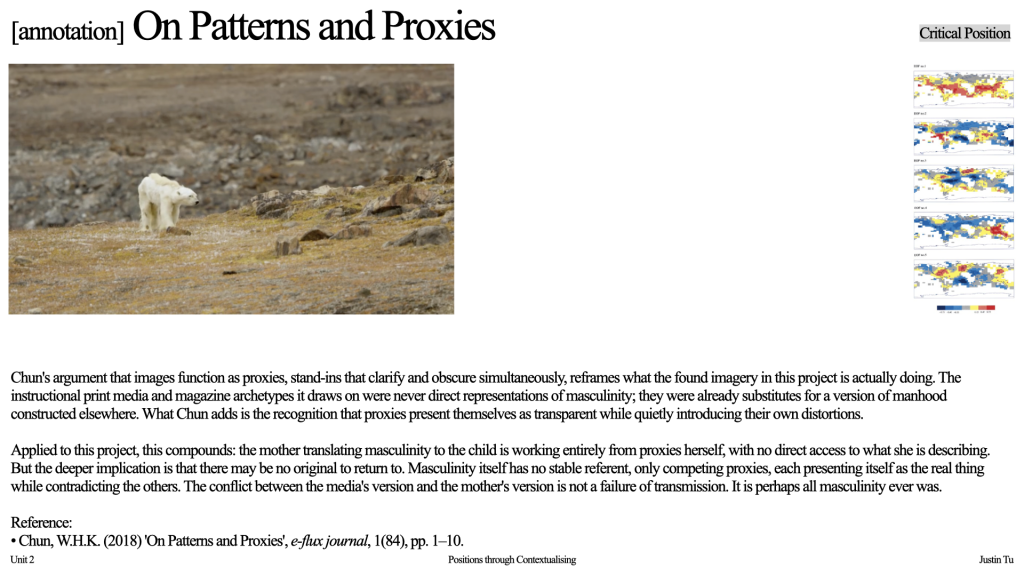
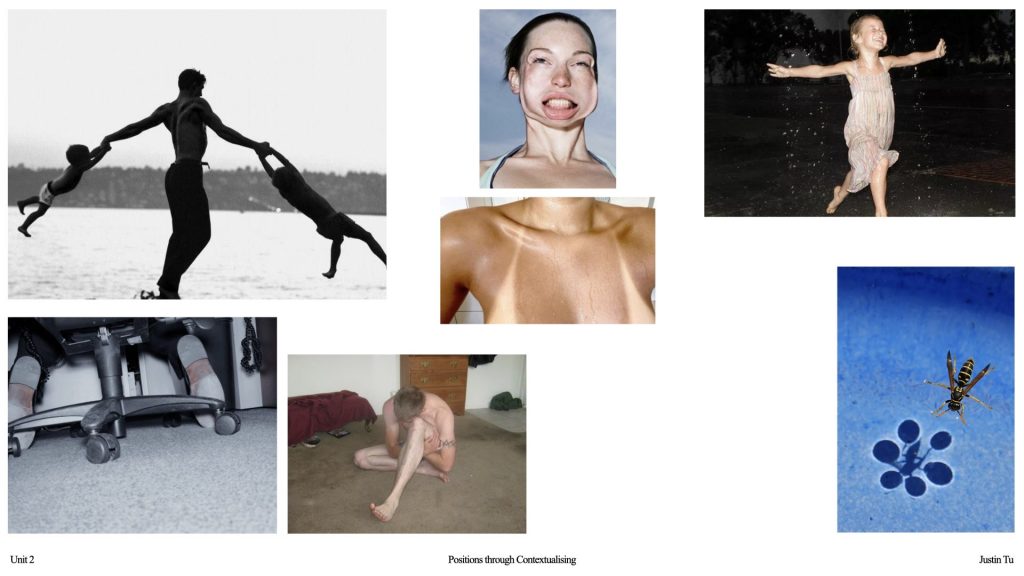
In On Patterns and Proxies (2018), Wendy Hui Kyong Chun examines how images function as proxies, stand-ins that represent complex or inaccessible realities. She argues that proxies both clarify and obscure meaning: they reduce uncertainty while simultaneously introducing new ambiguities.
Crucially, the same image can generate opposing interpretations, fostering both belief and skepticism depending on the viewer’s ideological position.
[test03] Proxies
Week2:
After experimenting with different ways of associating and combining imagery to create meaning, this week I’ve started refining my process into more intentional approaches.
[test01] Theme: Father
The first approach is working with a theme, and then intuitively selecting images from random books that somehow feel connected to that theme, whether visually, emotionally, or symbolically.
I decided on my theme based on a collage i did from previous experiment:
While assembling this collage, I drew on Batia Suter’s approach, focusing on formal resonance between the works. At the same time, there was an intuitive quality to the selection process—I found myself choosing images not only for their visual similarities, but also for an underlying urge to describe the father as a figure. There is a sense that it’s complicated and difficult to fully articulate.
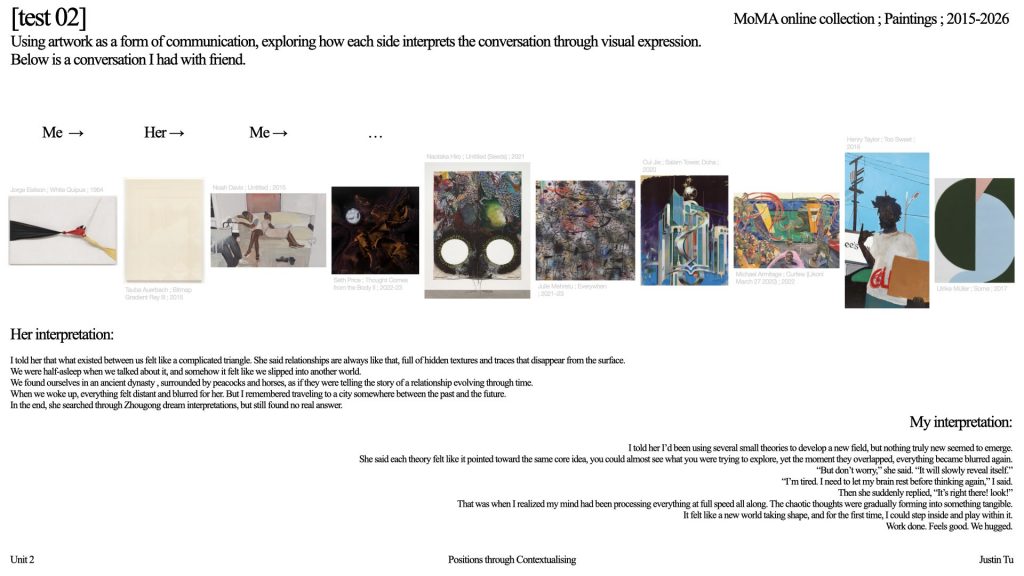
[test02] Communicate in Imagery
The second approach is having conversations using only imagery, and then dissecting those exchanges by looking at how I interpret them, how the other person interprets them, and how an audience might understand them differently.
Week3:
For my final week, I decided to expand the theme of the father into a broader context, considering the role father figures play in shaping the upbringing of men in my generation. I think the father figure is an interesting and deeply complicated role, not only on a personal level, but also in the way it reflects wider ideas of masculinity and how these ideas influence identity.
In most cases, mothers have been the emotional center of the family: physically present, emotionally accessible. Fathers, on the other hand, have historically occupied a more distant position — the structural pillar of the home, but rarely its emotional center.
I think my generation’s fathers may be among the last to exist in that particular way. As gender roles shift and family structures evolve, fathers are no longer defined solely as providers. But what I want to document is the contradiction many children of that generation grew up with. It was often through our mothers that we learned what a man was supposed to be. She described him, interpreted him, handed us the blueprint. But my father, when I actually looked at him, never fully matched that image. My understanding of him was assembled from fragments — things I was told, brief encounters, gestures caught in passing.
We inherited an idea of manhood secondhand. That contradiction is what I want to revisit through this project.
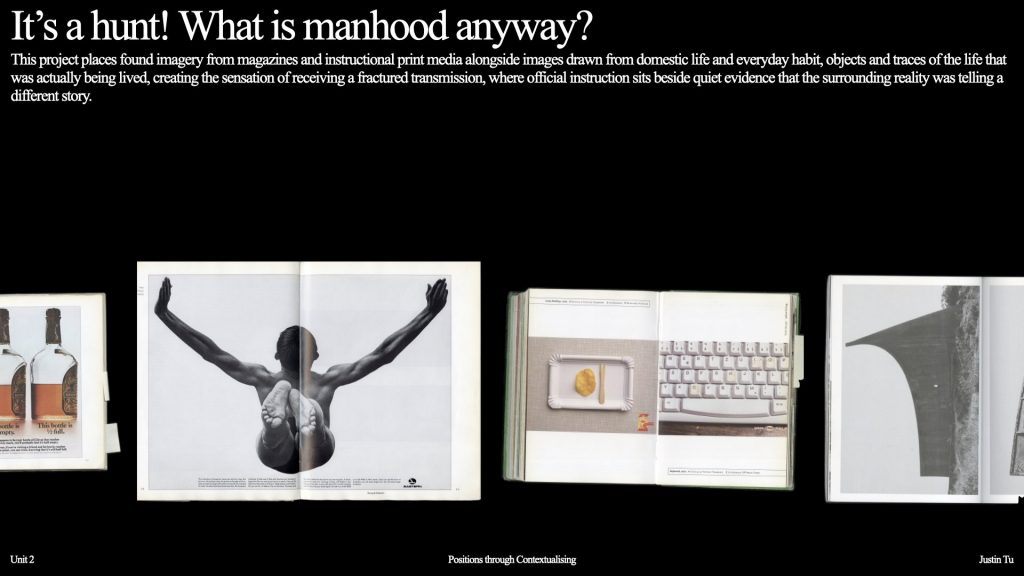
The project places found imagery from books, magazines and instructional print media alongside images drawn from domestic life and everyday habit, objects and traces of the life that was actually being lived, creating the sensation of receiving a fractured transmission, where official instruction sits beside quiet evidence that the surrounding reality was telling a different story.
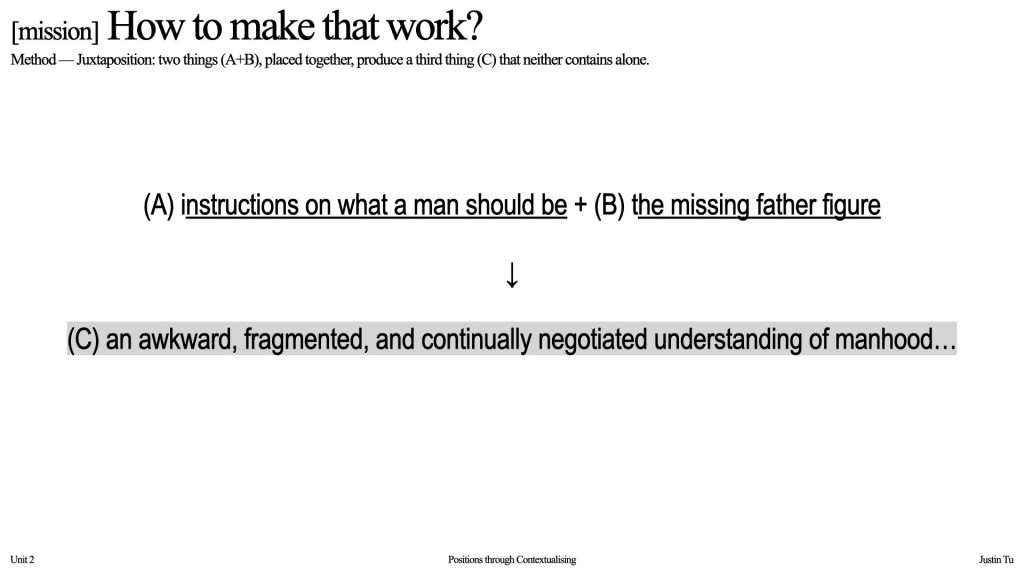
By using juxtaposition. Placing two ideas alongside one another to produce a third meaning that neither contains on its own.
In my case, the 2 ideas are: The instructions of what a man should be, communicated through my mother and through media representations; and, The absence of a father figure to reference, learn from, or measure oneself against (absence vs interpretation). What emerges from this tension is a third space: an awkward and the continually understanding of a manhood…
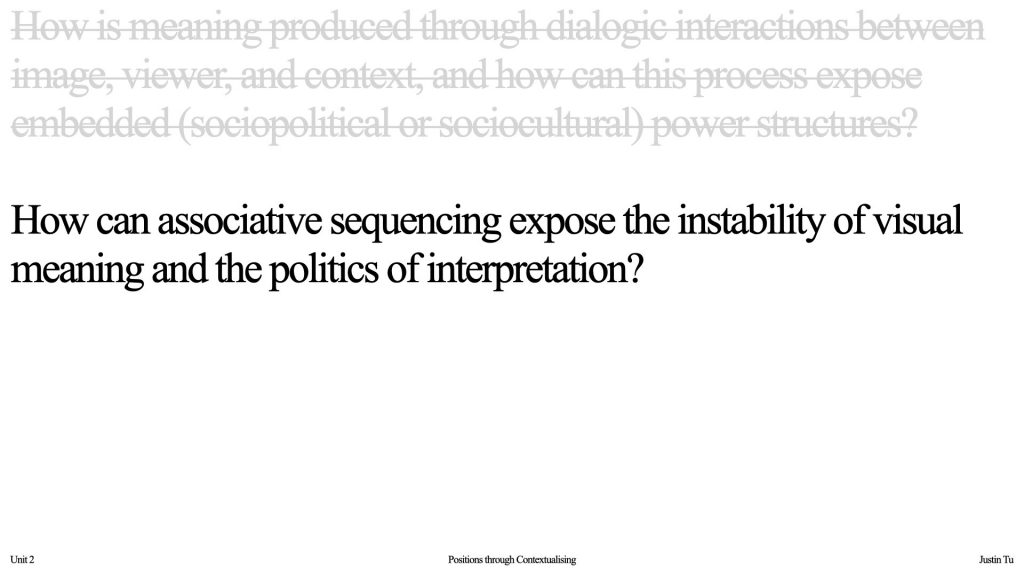
And that leads to my new enquiry:
Through juxtaposition making a visual field, I am trying to expose the instability of messaging and the ways we learn to navigate conflicting narratives. As seen in the publication, the imagery comes from a range of different sources, each carrying its own context and assumptions.
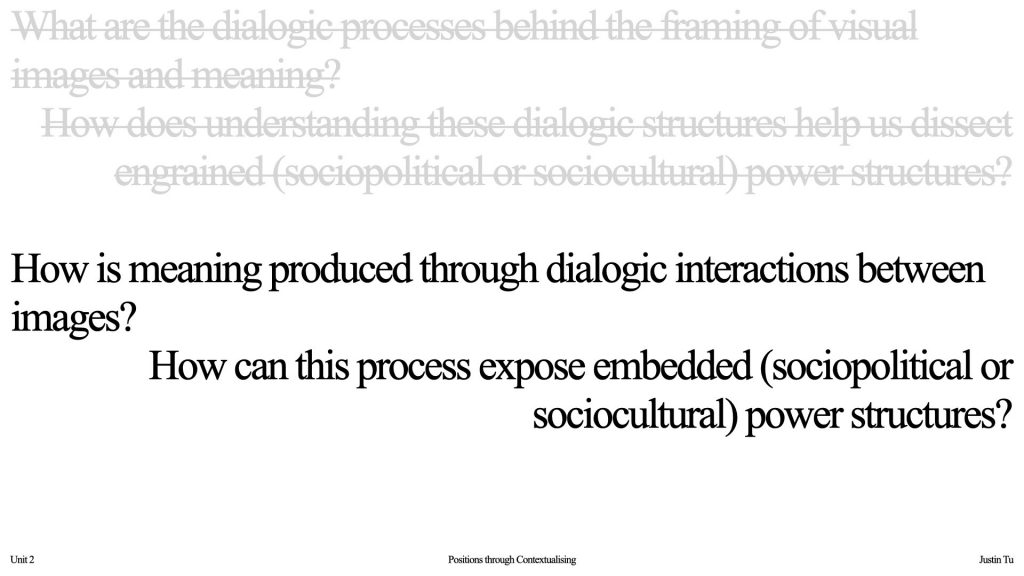
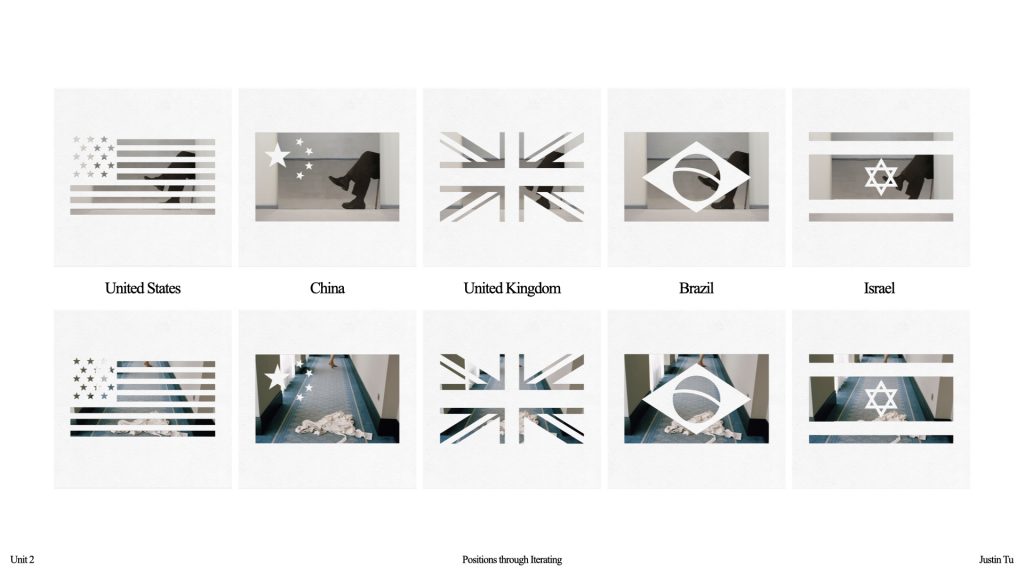
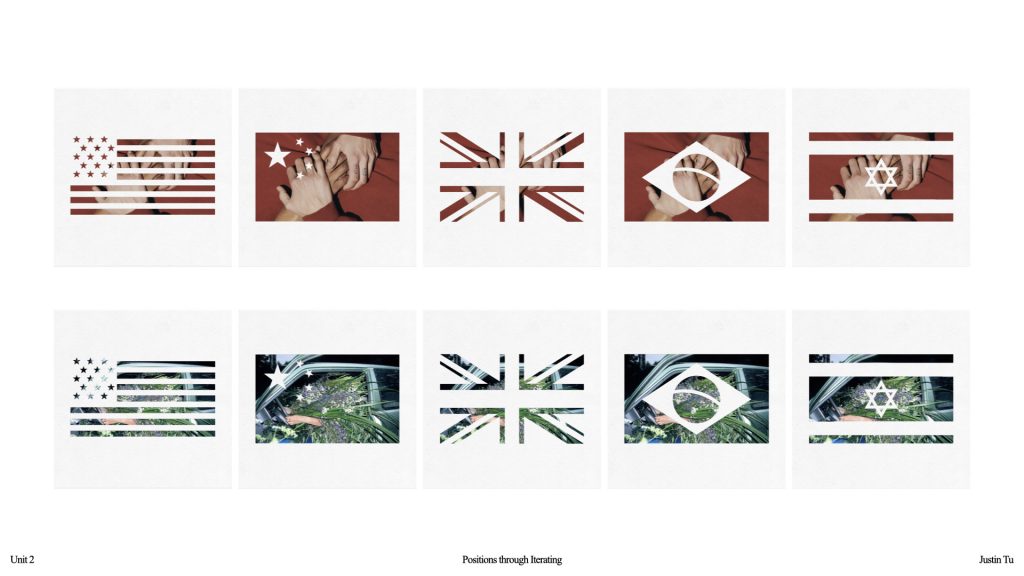
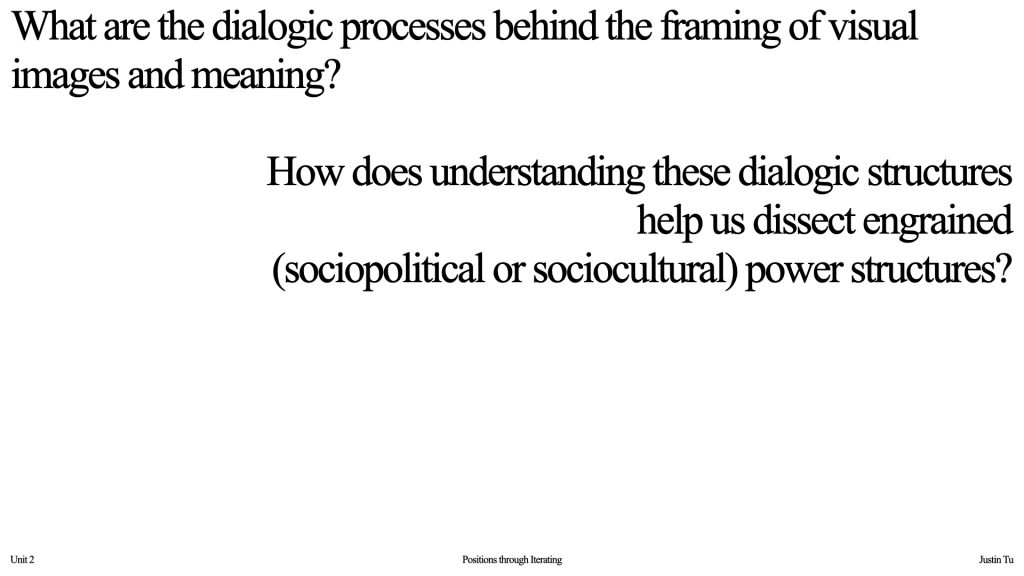
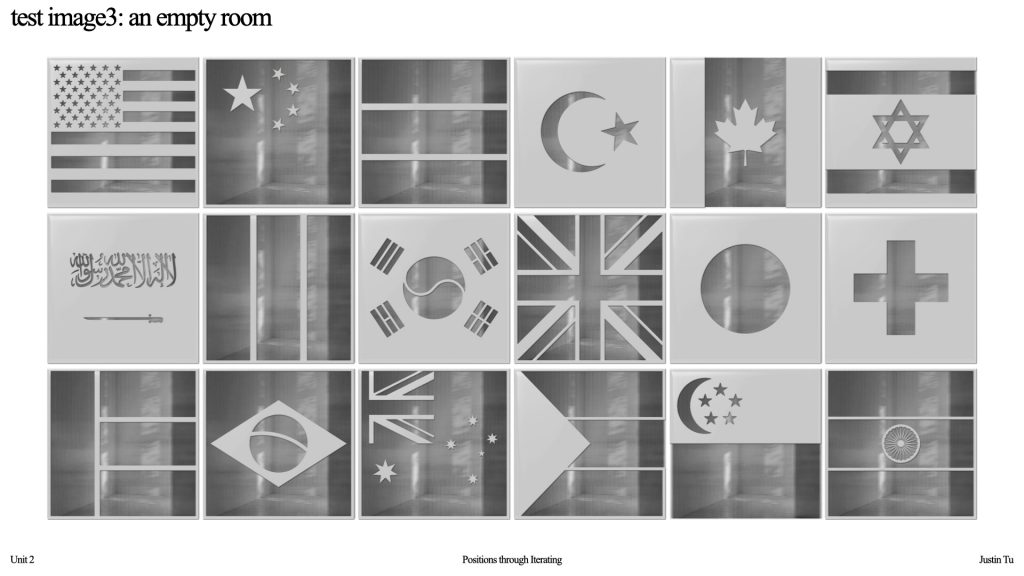
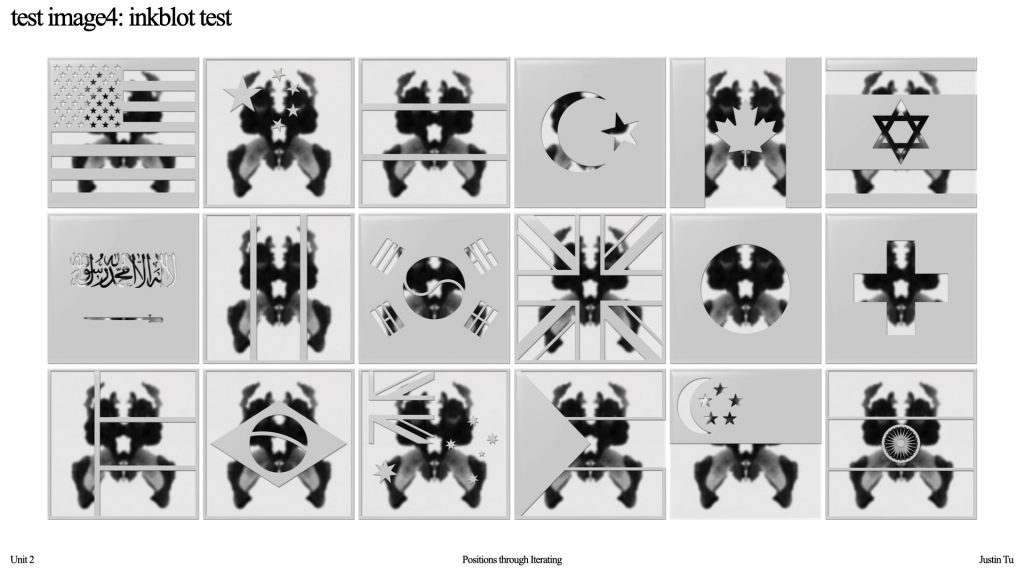
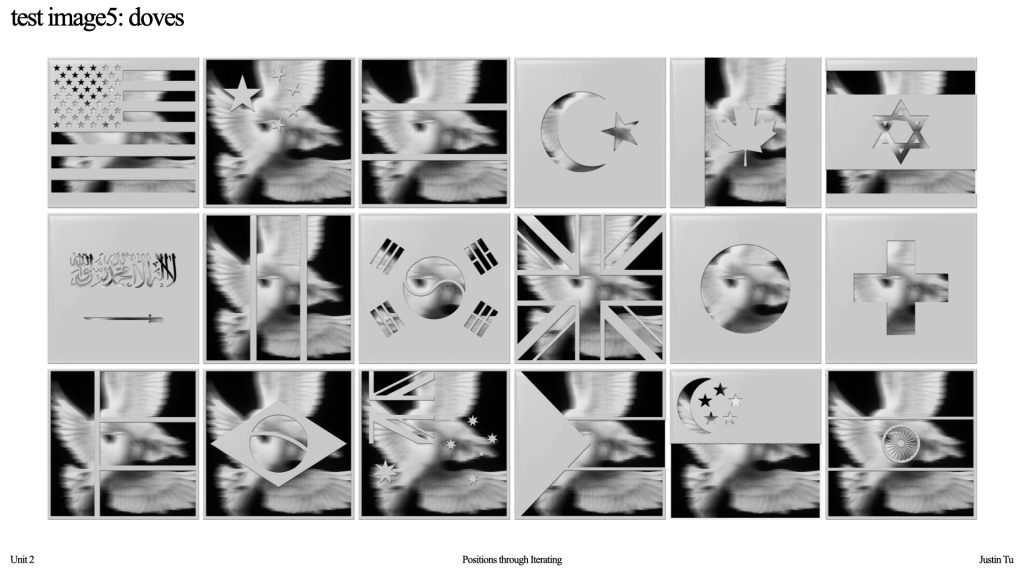
This project investigates the dialogic relationship between visual subjects and their framing devices, specifically exploring how nationalistic and sociocultural symbols dictate the interpretation of an image. I am exploring the central question: What are the dialogic processes behind the framing of visual images and meaning? How does understanding these dialogic structures help us dissect engrained (sociopolitical or sociocultural) power structures?
By placing identical photographs within different symbolic frames and presenting them side-by-side, I aim to expose the “silent dialogue” that occurs between the viewer’s existing biases and the visual cues provided. This methodology serves to dissect hidden sociopolitical power structures, revealing how institutional symbols can weaponize or sanitize a single reality depending on the cultural lens applied.
Ultimately, this work challenges the notion of “objective” sight. It examines the recursive loop of cultural framing: how we, as a society, frame our culture through icons, and how those very icons, in turn, frame our understanding of the world. Through this juxtaposition, the project seeks to reveal the engrained power dynamics that govern our visual literacy and political empathy.
Bibliography
1. Laranjo, F. (2014) ‘Critical graphic design: Critical of what?’, Modes of Criticism, 1. Available at: https://modesofcriticism.org. (Accessed: 22 April 2026) – from reading list
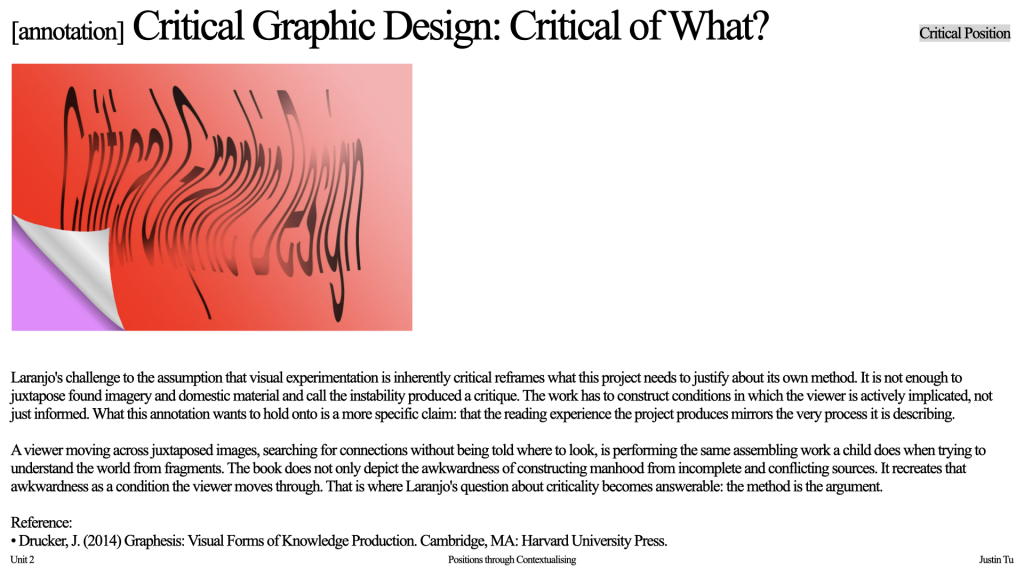
In this essay, Francisco Laranjo questions the ambiguous use of the term “critical” within graphic design, arguing that work is not inherently critical simply by addressing social or political issues. Instead, he outlines different modes of criticality, including reflexive practice, disciplinary critique, and engagement with broader societal conditions.
This text is relevant to my practice as it challenges the assumption that visual experimentation alone produces critical meaning. While my work explores how framing devices such as flags or symbolic icons alter interpretation, Laranjo’s argument prompts a deeper question: does the work merely illustrate bias, or does it actively construct conditions in which viewers confront their own assumptions? His emphasis on design as a form of inquiry supports my approach to collage not as aesthetic composition, but as a method for testing how meaning is produced through context, selection, and perception.
2. Drucker, J. (2014) Graphesis: Visual forms of knowledge production. Cambridge, MA: Harvard University Press. – from reading list
In Graphesis, Johanna Drucker argues that visual forms are not neutral representations of information, but active producers of knowledge. She introduces the concept of “graphic interpretation,” emphasizing that design structures how information is understood by shaping the conditions through which it is perceived. Rather than conveying fixed meaning, visual systems construct interpretive frameworks that guide how viewers read and make sense of content.
This is relevant to my practice, which investigates how framing devices influence perception. By applying different symbolic frames to the same image, I explore how interpretation shifts depending on the visual structure imposed. Drucker’s argument supports the idea that these frames do not simply alter meaning externally, but function as interpretive systems that produce distinct readings. This positions my use of collage not as aesthetic manipulation, but as a method for examining how meaning and knowledge are constructed through visual form.
3. Gómez-Peña, G. and Fusco, C. (1993) The Couple in the Cage: A Guatinaui Odyssey [performance]. – topic
Guillermo Gómez-Peña and Coco Fusco’s The Couple in the Cage (1992–1994) explores how cultural identity and “otherness” are constructed through pre-existing colonial and national frameworks of understanding. By presenting themselves as fictional “undiscovered Amerindians” displayed in a cage, the work reveals how audiences interpret unfamiliar bodies through inherited narratives shaped by colonial history, exoticism, and institutional authority. The reactions of viewers ranging from belief to amusement demonstrate how perception is guided not by what is seen, but by what cultural expectations already exist.
In relation to this project, the work is relevant for its focus on how cultural and historical frameworks shape interpretation of identity and difference before direct engagement with the subject occurs. It highlights how meaning is not neutral but constructed through social and national narratives that condition the viewer’s reading of visual and embodied information. This directly connects to the project’s investigation into how symbolic framing devices influence interpretation.
4. Shibuya, S. (2021) Headlines. New York: Abrams. – method
In Headlines, Sho Shibuya paints over the front pages of The New York Times, using the newspaper not only as material but as a framing device. While much of the original content is obscured, the recognizable layout and authority of the newspaper remain intact. This frame situates the work within the context of daily news, implicitly signalling “what happened today.”
As a result, the painted surface becomes a subjective response to current events rather than a direct representation of them. The work translates information into atmosphere, where colour and composition reflect an emotional reading of the day. This is relevant to my practice, as it demonstrates how a frame alone can impose meaning. Even without explicit content, the New York Times format conditions the viewer to interpret the image as timely and significant, suggesting that context can define perception as much as visibility.
5. Tillmans, W. (2005) Truth study center. London: Tate Modern. – critical position
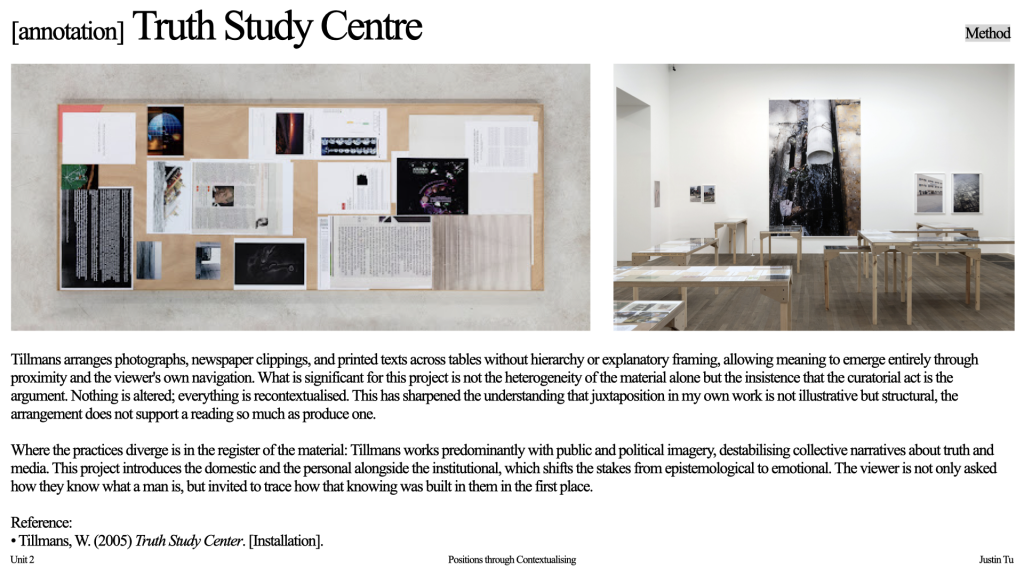
Tillmans’ installation resists the logic of the singular frame. Rather than imposing an interpretive structure, Truth Study Centre distributes material across tables in a way that stages the instability of meaning — proximity creates association, but no arrangement is authoritative. The viewer’s navigation becomes part of the work’s meaning-making, and the “truth” of the title is deferred rather than delivered.
This functions as a productive counterpoint to my own methodology rather than a direct precedent. Where Tillmans suspends the frame to expose the contingency of interpretation, my project imposes frames explicitly, testing what happens when symbolic authority is made unavoidable rather than withheld. Placing the two approaches in dialogue raises a question my work needs to answer: is an imposed frame a more honest or more coercive form of meaning-making than one left deliberately open? Whether imposing a frame is more honest or more coercive than withholding one remains genuinely unresolved.
5. The Warburg Institute (no date) Virtual tour: Aby Warburg: Bilderatlas Mnemosyne exhibition at Haus der Kulturen der Welt. Available at: https://www.sas.ac.uk (Accessed: 22 April 2026). – critical position
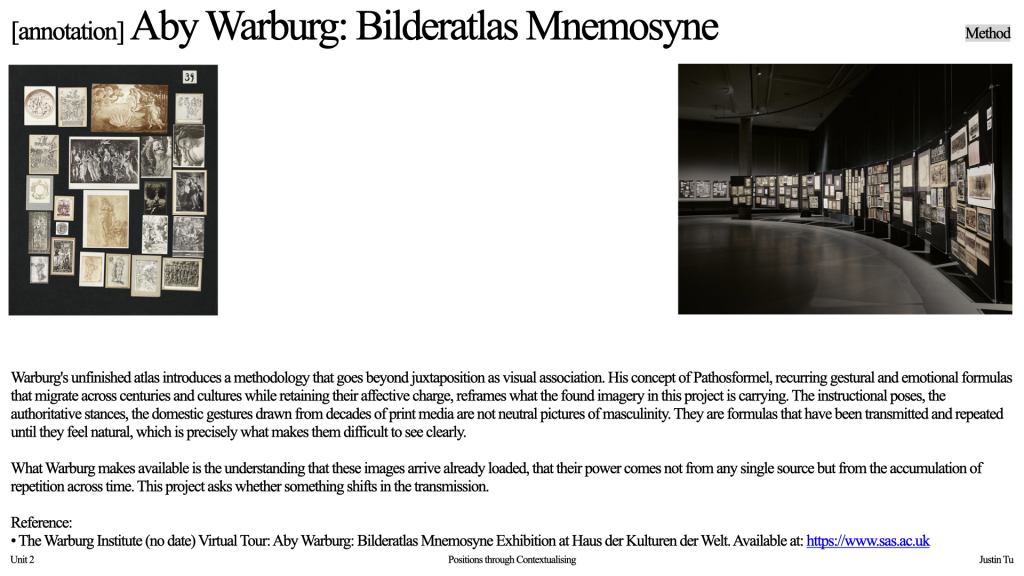
Aby Warburg’s Bilderatlas Mnemosyne (1920s) is an unfinished visual research project that assembles images from art history, mass media, and cultural artefacts onto black panels. Rather than presenting a fixed narrative, Warburg employs juxtaposition to produce meaning through visual relationships, allowing images to be reinterpreted across different historical and cultural contexts. This approach positions the display as an active site of knowledge production, where meaning emerges through association rather than being inherent to individual images.
In relation to this project, Warburg’s methodology is significant for its use of juxtaposition and contextual framing as mechanisms that generate interpretation. By placing identical or related images within different symbolic frameworks, the project similarly activates multiple readings shaped by sociopolitical context. Warburg’s emphasis on the migration of symbols and cultural memory reinforces the idea that visual meaning is contingent, constructed, and dependent on the conditions in which an image is encountered.
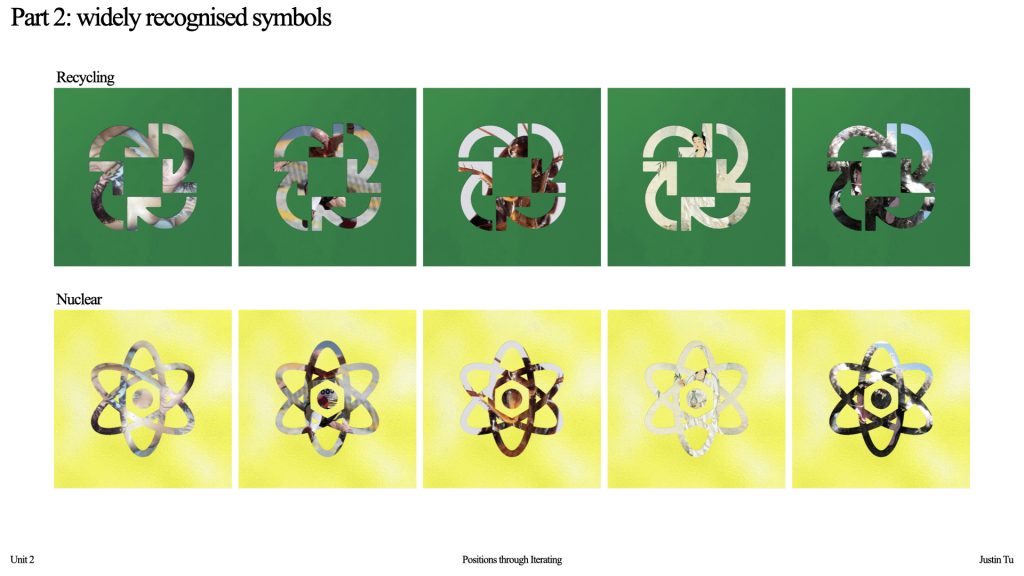
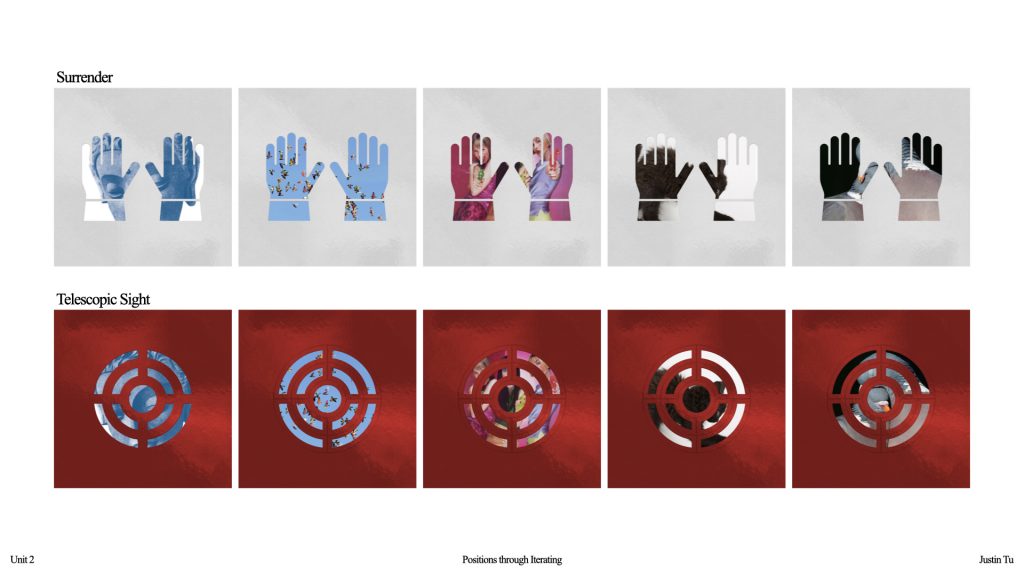
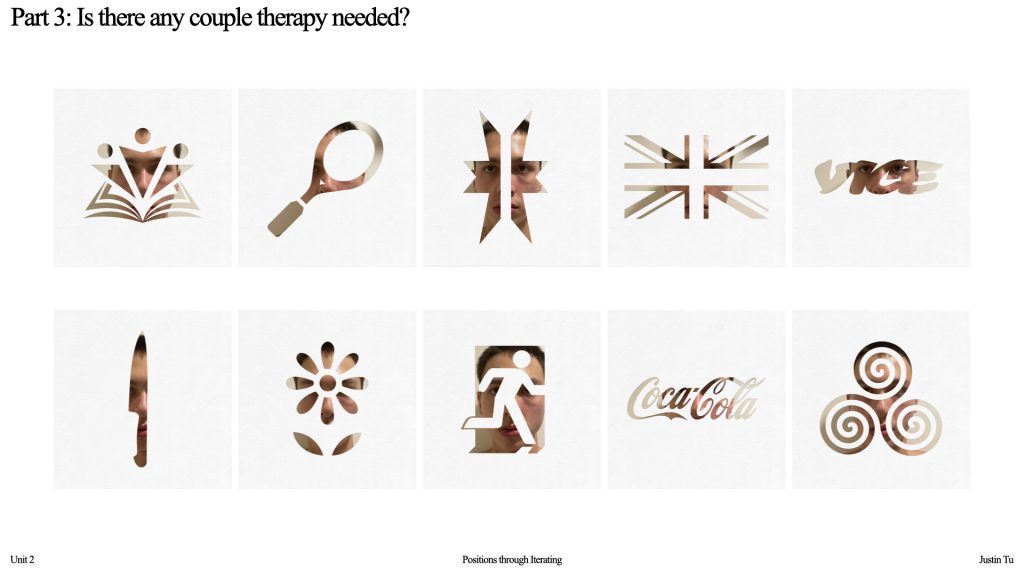
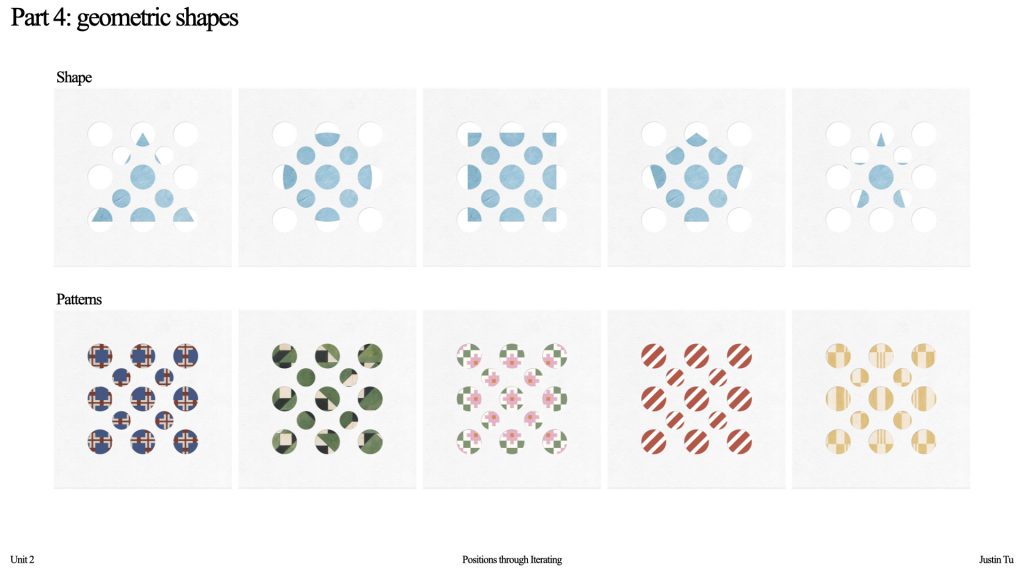
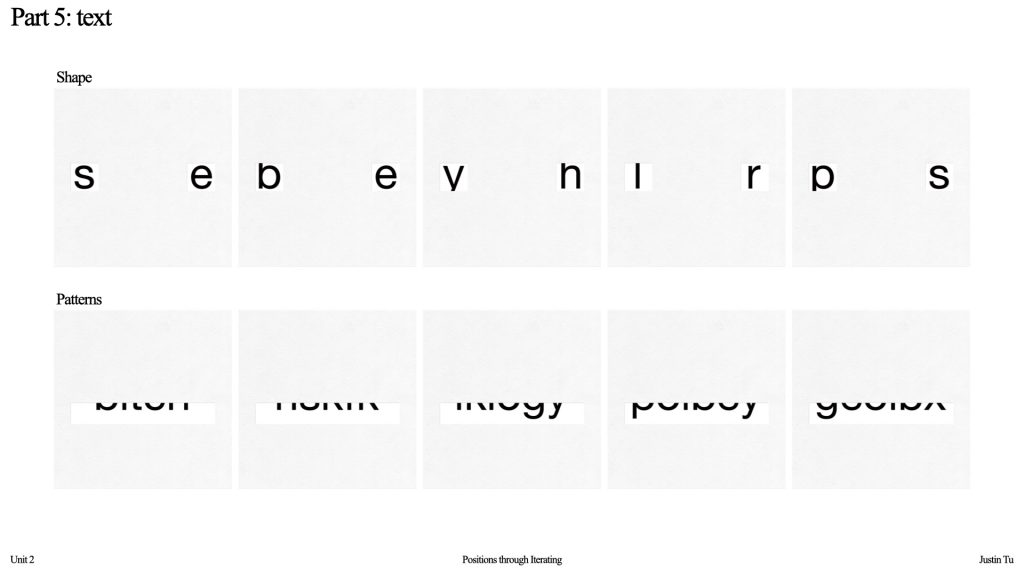
My practice has mainly focused on social issues around perception and hidden bias, often inviting viewers to reflect on their own assumptions through interaction. A recurring method in my work is the “cutout” as an act of revealing, uncovering what is otherwise obscured. Through this project, I want to push this further by examining how the cutout itself can shape meaning, and how subtly it can influence perception.
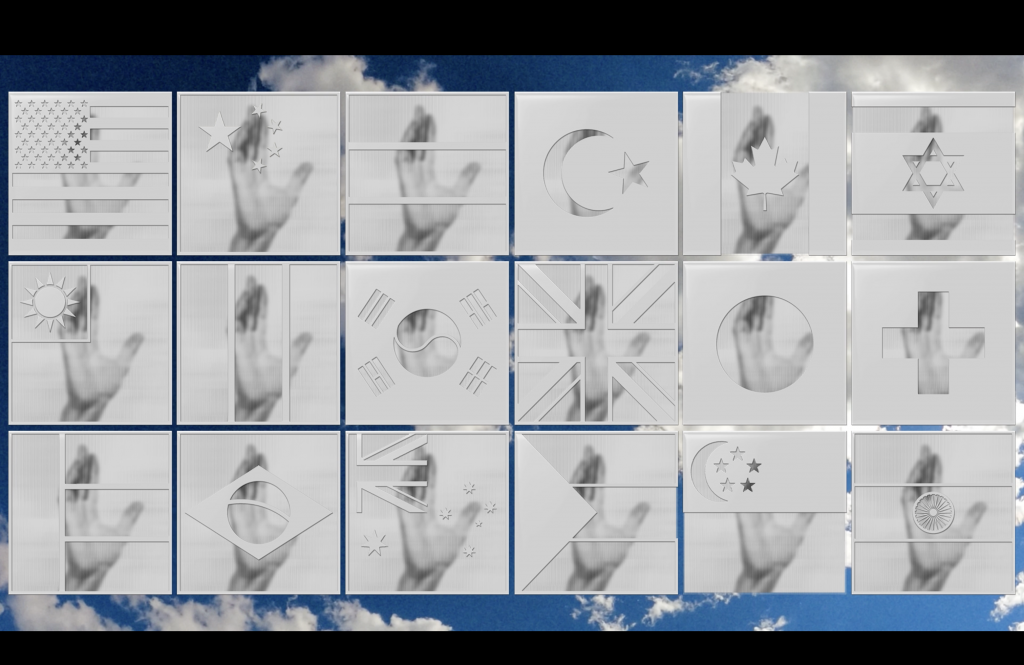
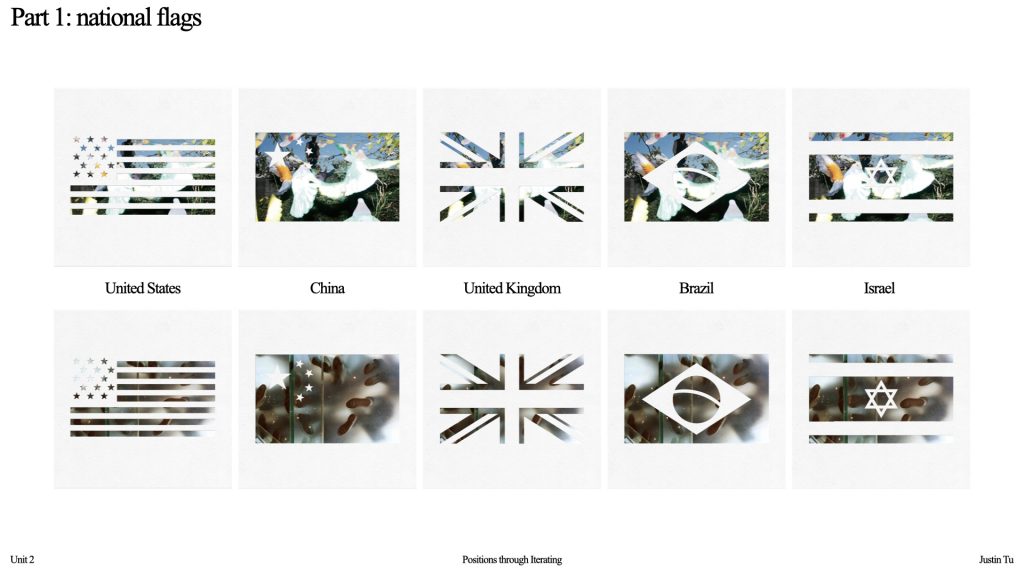
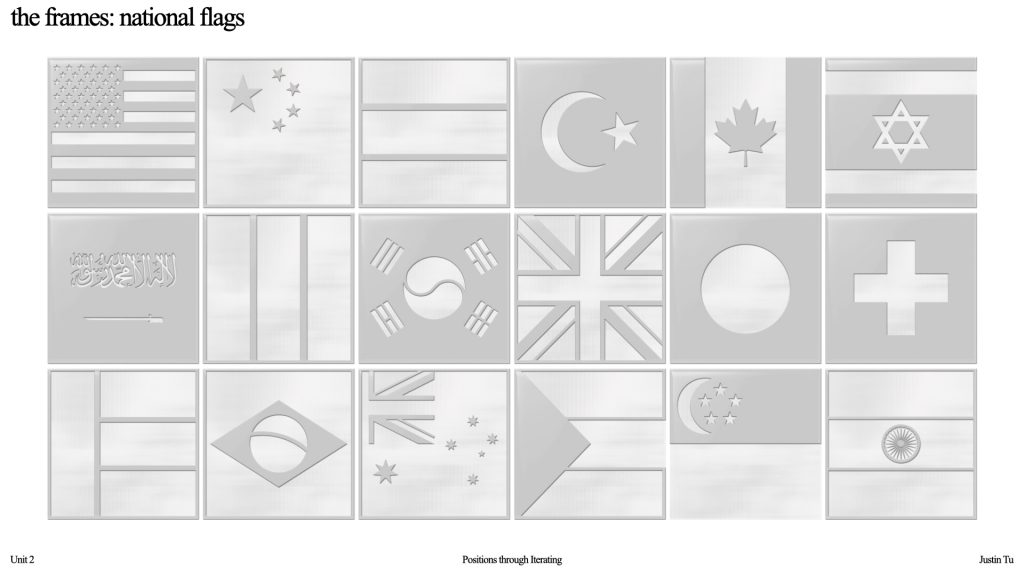
In the first part, I used different national flags as cutouts to view the same image. Each country carries its own cultural, political, and emotional associations, which may influence how the image is interpreted.
In the second part, I used familiar, widely recognized symbols to create the cutouts. I’m interested in whether these symbols also affect how we perceive an image even when the symbol itself has no direct connection to what is being shown.
In the third part, I experiment with using different symbols to reflect on how I relate to my partner. Through these associations, I begin to question whether the connections I make reveal something about the relationship itself, almost like an informal, visual form of self-examination.
In the forth part, I took a more literal approach, using shapes to define and constrain other shapes or patterns.
In the fifth part, I draw on something similar to the hangman word game. I focus on which words come to mind immediately, and consider whether these instinctive responses are linked to my personal habits, interests, or subconscious patterns. However, this part is less about how shape influences meaning, and more about how limiting information shapes what can be perceived and understood.
Week2: Framing Thoughts
Previously, I focused on how the “cutout’s shape” — which I now prefer to call it “frames” — alter the way we see and interpret images. I found that symbols carrying a high density of meaning tend to dominate interpretation. But, when a symbol becomes too powerful, does it reduce our capacity for critical judgment?
This led me to ask:
This week, I extended this enquiry through a series of iterations focusing on national flags as a case study. I explored not only how to construct image combinations that encourage reflection, but also whether anything can counterbalance or exceed the influence of such dominant symbols.
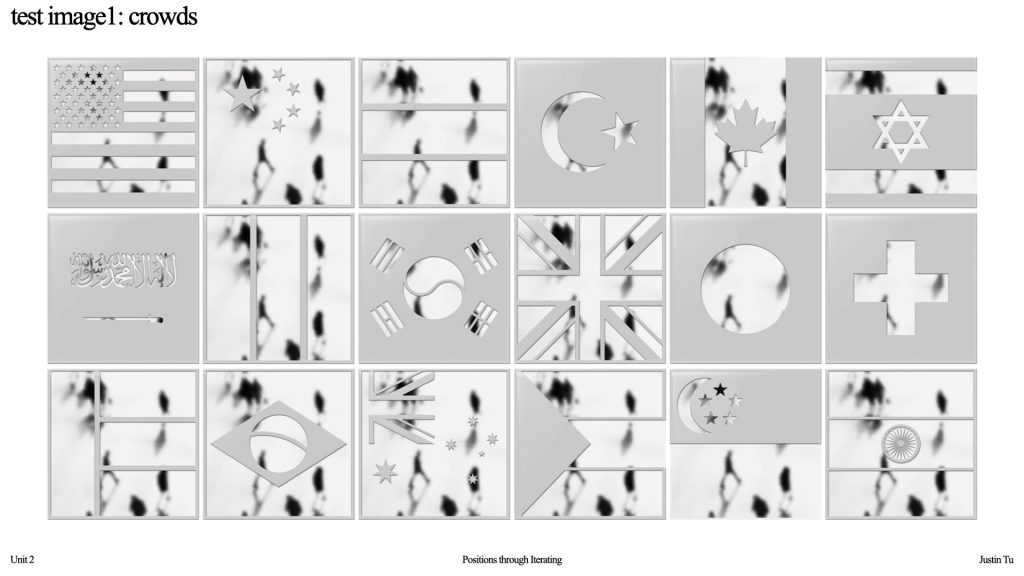
In the first set, I used crowds. Depending on the framing, the same group can appear like a group of ‘celebrants’, a ‘threatening mob’ or even people ‘in hiding’. Does the frame creates the ‘why’ behind the gathering?
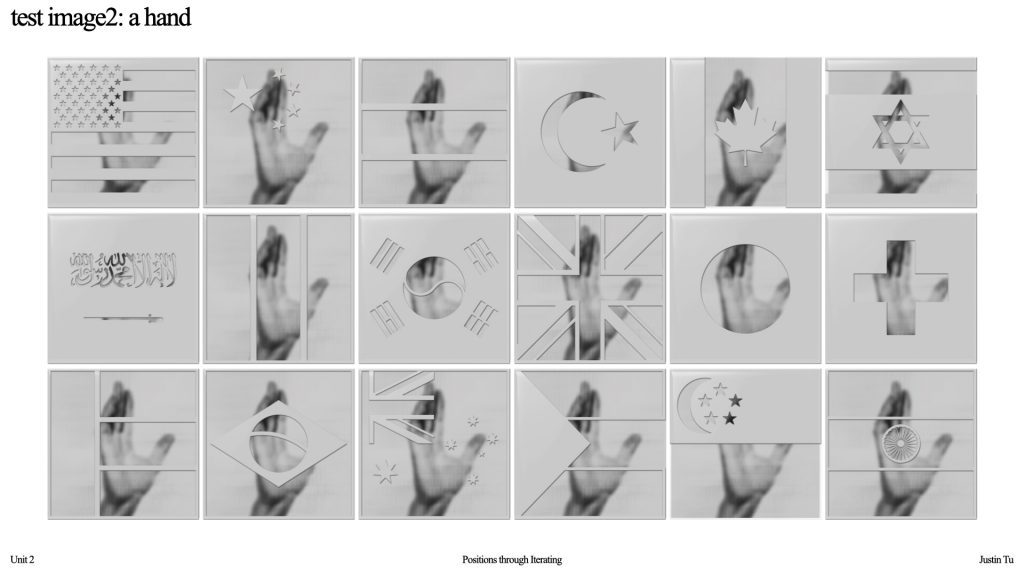
The second set I used a hand. A raised hand is a universal symbol, but it’s incredibly malleable. Is it a sign of participation? A question? Or a salute? Does the frame decide the intent of the body?
The third set I used an empty room. We often learn a lot about a person by the traces they leave in a space, but when the room is stripped of everything, that sense of identity disappears. It becomes ambiguous. Could it be a quiet gallery hallway, or a cold detention room somewhere remote?
The fourth set I used one of the inkblot from Rorschach inkblot test. Apparently people would see completely different things in the same inkblot depending on their experiences and mindset. And I wonder if this would be effected by the frame. What do you see?
In the fifth set, I tested a highly symbolic imagery. Here, I am testing whether one powerful symbol can offset or destabilise another, particularly the strong visual authority of national flags. Does it give civil war or does it just give world peace?
Through this juxtaposed mode of viewing, I wish to highlight that strong symbols such as national flags can both unify and divide. At the same time, they often suppress alternative interpretations and reinforce existing sociopolitical power structures.
This raises a broader question about how meaning is constructed.
Through reviewing environmental datasets and references with my group, I realised climate justice is not only negotiated through policy but also through everyday consumption systems that designers actively shape. Although climate discourse has been prominent for over a decade, I recognised that I had internalised it as distant and overwhelming rather than actionable. This project shifted my perspective as a practitioner: instead of imagining change as large-scale and inaccessible, I began to focus on designing small, implementable systems that influence daily behaviour.
I consequently reconsidered graphic design not as a one-directional act of raising awareness, but as a framework for structuring participation. We applied this approach by developing a canteen system in which each stage, choosing, purchasing, eating, and disposing operates as a learning interface. The proposal supports institutional sustainability goals by embedding guidance directly into user experience rather than presenting information separately. By prioritising seasonal, high-quality produce, it aims to reduce energy demand and food waste while encouraging responsible consumption.
This process reframed my role from communicator to facilitator, positioning my practice within climate justice as one that enables agency, accessibility, and collective accountability.
Bibliography
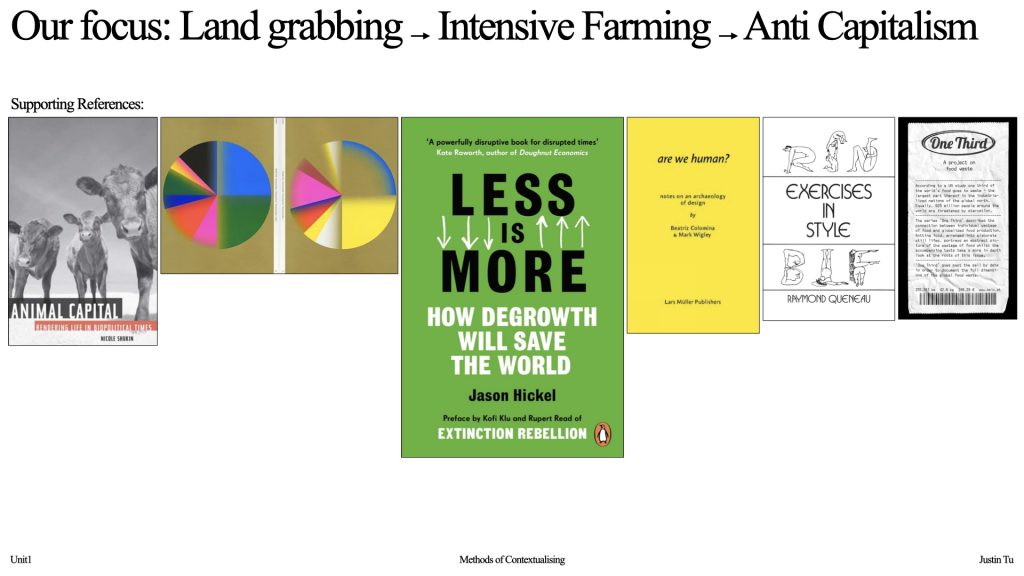
1. Jason Hickel (2020) Less Is More: How Degrowth Will Save the World. London: William Heinemann.
This text examines Enlightenment philosophy, particularly the ideas of Descartes and Bacon, as foundational to a hierarchical worldview that separates humanity from nature and legitimizes extraction. By tracing how colonial power classified racialized subjects as closer to “nature,” the author reveals epistemological links between ecological exploitation and social domination.
This framework clarifies how contemporary capitalist economies continue to organize resource use through asymmetrical power relations. It also reshaped our understanding of the food system: rather than interpreting intensive agriculture as a technical or policy failure, we began to see it as an extension of a longer intellectual history that normalizes control over land and bodies. Because the text operates at a macro-historical scale, we were required to translate its claims into situated design strategies. This tension led us to foreground seasonal, local plant-based consumption not as lifestyle advice, but as a design intervention that challenges extractive logic within everyday practice.
2. Nicole Shukin (2009) Animal Capital: Rendering Life in Biopolitical Times. Minneapolis: University of Minnesota Press.
In Animal Capital, Nicole Shukin theorizes how animal life functions simultaneously as material resource and symbolic currency within capitalist systems, a dual process she terms “rendering.” This concept was pivotal to our enquiry because it reframed industrial food production not simply as agriculture but as a representational economy in which animal bodies circulate as signs, commodities, and surplus value. Rather than treating meat production as an ethical issue alone, Shukin’s analysis situates it within biopolitical regimes that manage life itself as extractable capital.
This shifted our project away from a narrow sustainability framework toward examining how visual culture, branding, and consumer narratives normalize extraction.Particularly influential was her claim that capitalist systems depend on representational strategies that obscure the violence and material costs of extraction. Recognizing this mechanism directly informed our design methodology: instead of presenting food as a finished dish, we visualize the emissions and resource data embedded within it. In this way, our project adopts Shukin’s critical framework as a visual strategy, transforming concealed infrastructures into perceptible information and repositioning design as a tool for rendering hidden systems legible.
3. Beatriz Colomina and Mark Wigley (2016) Are We Human? Notes on an Archaeology of Design. Zürich: Lars Müller Publishers. – from reading list
In Are We Human? Notes on an Archaeology of Design, Beatriz Colomina and Mark Wigley argue that design does not merely surround human life but actively produces it, positioning humans themselves as outcomes of designed systems. This claim reframed our understanding of design from a communicative tool into an evolutionary force that structures perception, behaviour, and knowledge. Rather than seeing our project as simply visualizing environmental data, we began to interpret it as participating in the ongoing construction of how ecological reality is understood.
The authors’ assertion that we are “suspended in design” was particularly generative, prompting us to consider how informational formats shape what counts as visible or actionable knowledge. While their argument operates at a broad philosophical scale, translating it into our project required grounding it in specific visual decisions. This led us to treat data not as neutral content but as a co-authorial agent, where the act of redesigning information becomes a reciprocal process through which both viewer and dataset are reconfigured.
4. Hezin O (2018) ‘Gaji #9: Paper and Offset Print’. Interview with It’s Nice That. Available at: itsnicethat.com (Accessed: 20 February 2026).
The interview published by It’s Nice That on Hezin O emphasizes process as the source of meaning rather than a neutral production step. Discussing her work with silkscreen and Risograph printing, she highlights how visible dot structures reveal that gradients are optical constructions rather than seamless images. This attention to pre-image systems, grids, units, angles, and line densities reframed our understanding of visual language as something built from rule-based frameworks rather than expressive surfaces. Her calendar project was particularly influential because it translates numerical time into a visual syntax generated entirely through printing logic, demonstrating how information can be structured through material constraints.
This methodological approach directly informed our own strategy for visualizing hierarchical data: instead of illustrating information descriptively, we began constructing it through systematic visual grammars that make structure perceptible. While the article functions primarily as a practitioner interview rather than theoretical text, its emphasis on procedural thinking provides a practical model for how design methods themselves can encode meaning, positioning technique as an epistemological tool rather than a neutral medium.
5. Queneau, R. (1998) Exercises in Style. London: John Calder. – from reading list
In Exercises in Style, Raymond Queneau systematically retells a single ordinary event in dozens of stylistic variations, transforming linguistic constraint into an experimental method for testing how form alters meaning. Rather than treating language as a neutral vehicle for content, the work demonstrates that structure, tone, and format actively produce interpretation. This procedural logic was particularly influential for our project, which approaches data visualization as a series of formal experiments rather than a single optimized solution. By repeatedly redesigning the same informational content through different textual and graphic systems, we began to assess how shifts in representation affect legibility, authority, and pedagogical impact.
Queneau’s method encouraged us to treat variation not as decoration but as research, using iterative translation to probe the limits of comprehension. While his work operates within literary language, adapting this approach to visual communication required us to extend stylistic experimentation into diagrammatic and informational forms, positioning design iteration itself as an investigative tool.
6. Klaus Pichler (2012) One Third. Ostfildern: Hatje Cantz.
In One Third, Klaus Pichler stages discarded food in the visual language of classical still-life photography and pairs each image with statistical information about global food waste. By juxtaposing aesthetic seduction with quantitative evidence, the work demonstrates how representation can shift from passive depiction to critical disclosure, revealing the infrastructural realities embedded within everyday consumption. This strategy was particularly influential for our project because it models how data can function as a perceptual intervention rather than supplementary information. Instead of treating environmental statistics as explanatory captions, we began to integrate them directly into the visual system of each dish, allowing emissions data to actively reshape interpretation at the moment of viewing.
Pichler’s approach suggests that when information is encountered simultaneously with the object it describes, it has the potential to alter judgment and choice. While his work operates within a photographic and exhibition context, translating this logic into a design framework prompted us to consider how informational visibility might influence real-time decision-making, positioning data visualization as a behavioural catalyst rather than a descriptive layer.
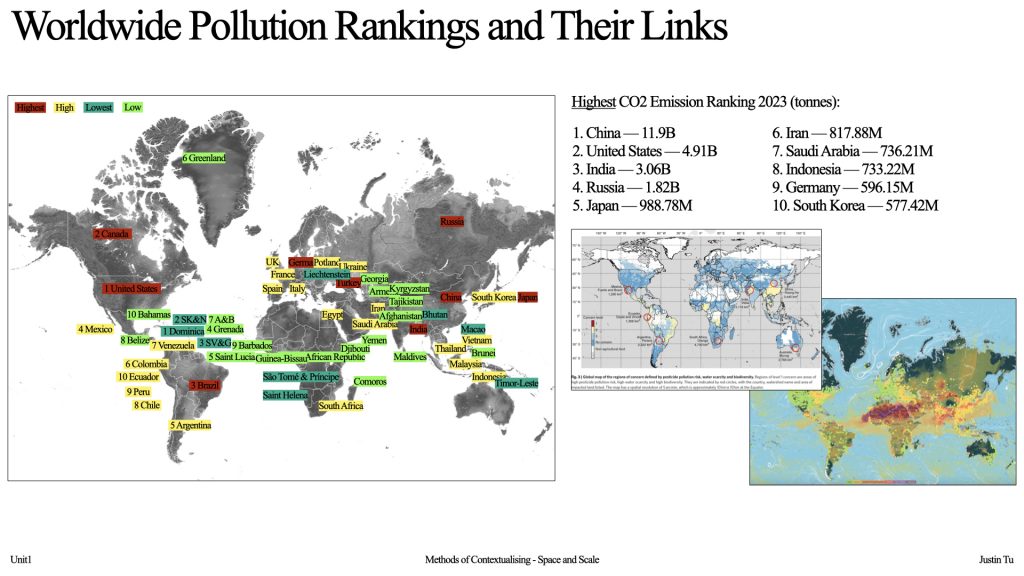
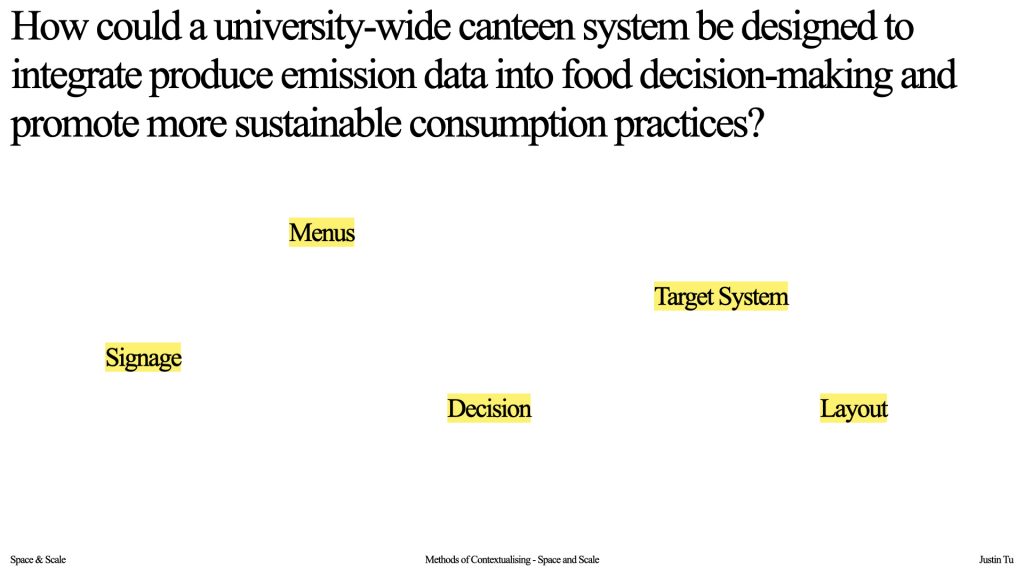
As we are working on the theme of “Space & Scale”, we wanted to first actually understand how the impacts of climate change are felt both locally and globally, so we started by gathering pollutions information from around the world. We pulled together the informations we found on different platforms including air quality rankings, water pollution rankings, and most importantly emissions data and started mapping.
When you look at this you can tell countries that were historically colonisers tend to appear cleaner, while many formerly colonised regions show heavier pollution. It’s not a random distribution, and it raises questions about how those historical power structures still shape environmental conditions today.
Our Primary Reference: Less is More This text traces how Enlightenment thought established a hierarchy separating humans from nature, legitimizing extraction and colonial power. It reframed our view of intensive agriculture not as a policy flaw, but as part of a longer history linking land control, capitalism, and domination.
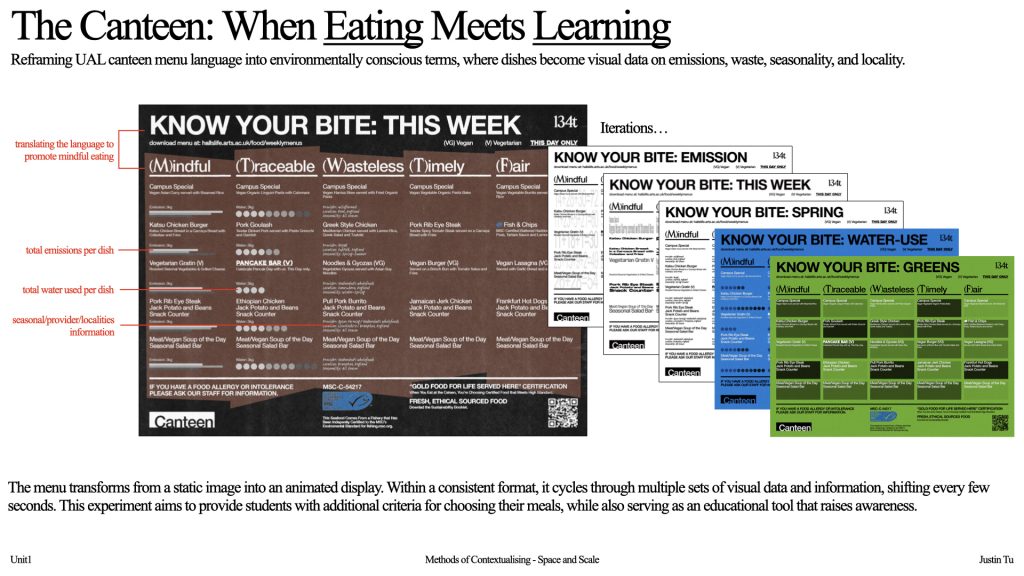
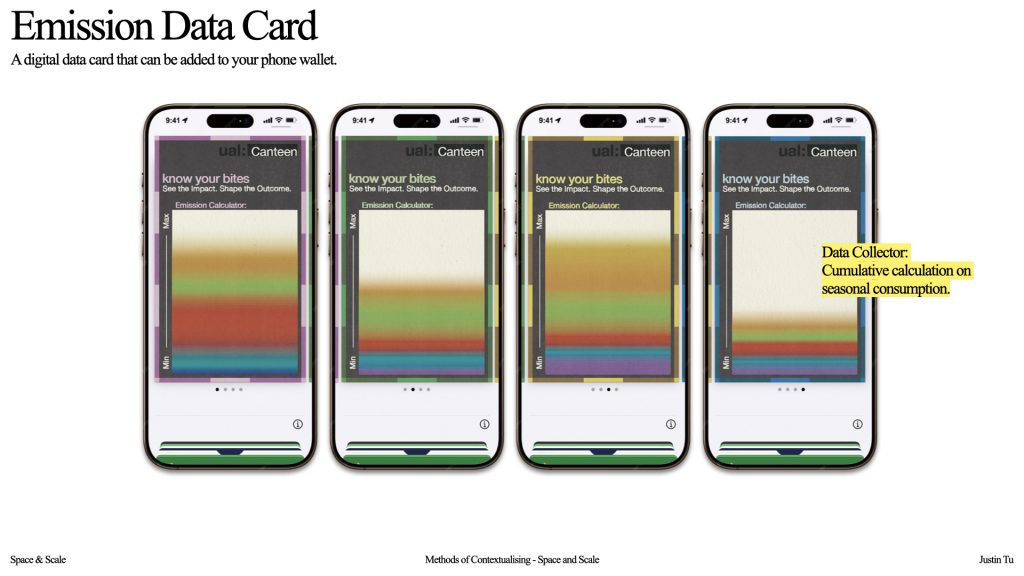
We then decided to focus on anti capitalism and intensive farming, exploring ways we can reduce overall waste and raise awareness about what we buy and eat. And this is where our project “know your bites” began, which explores the emissions of different foods and their environmental impact within UAL.
This led us to focus on the university canteen system. When we started researching about the food served across UAL canteens, we found out that they had already done such a great job — the system is quite sustainable and mindful of its environmental footprint. However, we noticed that very few students are aware of this, or of the environmental impact of the food they choose to eat.
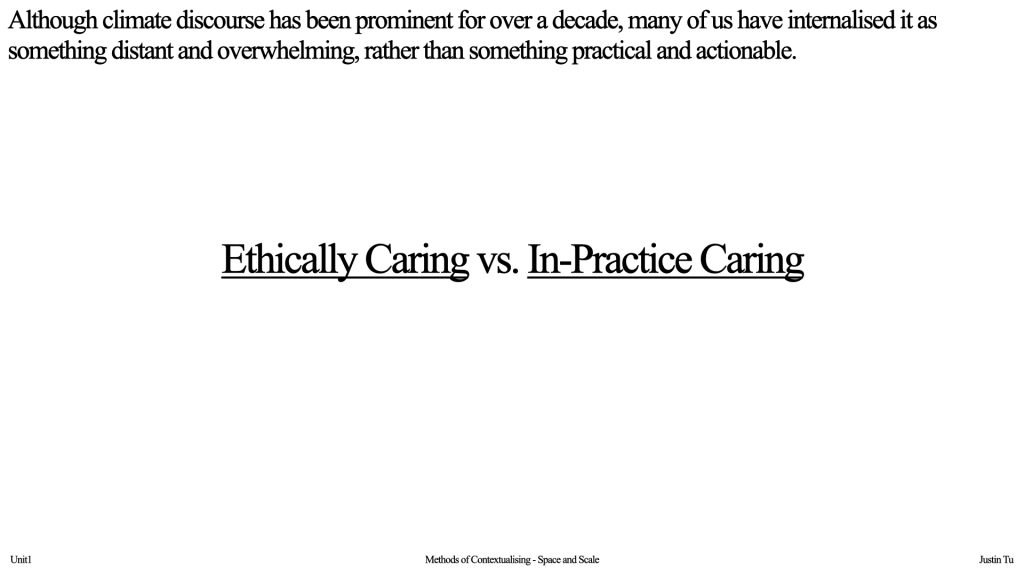
We identified two types of care when it comes to environmental issues: ethical caring and in-practice caring. Ethical caring describes students who care about the issue in principle but don’t actively engage in ways that create change. In-practice caring, on the other hand, refers to students who take action, they educate themselves, make conscious choices, and have a tangible impact.
But we need them both.
This insight led us to ask: how can we make sustainable action feel easy and accessible in everyday life? Specifically,
With that question in mind, we began developing a system that not only informs people about the impact of the food they eat, but also actively engages them, making sustainability something they can participate in, rather than just think about.
We estimated carbon footprint for each dish that we calculated. To calculate the emission of each dish we used the food carbon footprint calculator developed by « My emissions » a carbon reporting platform that works with brand to reduce their food carbon footprint. While calculating these data we put the different food into broader categories to create a system that would be easy to understand visually while still being impactful.
And to encourage students to move into in-practice caring, we wanted to make sustainable choices feel intuitive and approachable. We approached this by encouraging people to think about eating seasonally and buying locally.
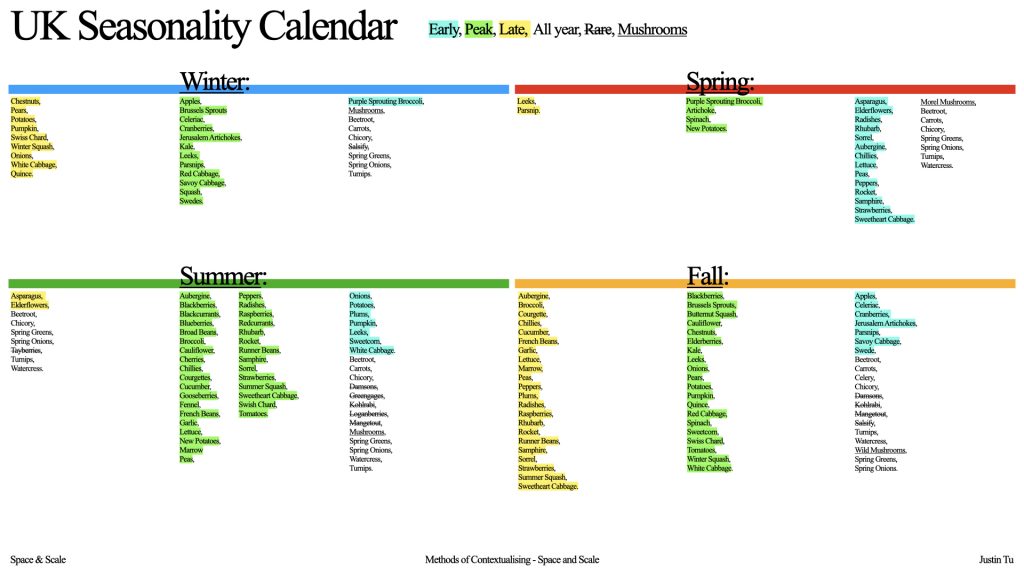
We began by mapping out UK produce across the year, organising it to show when items are early, peak, or late in their season.
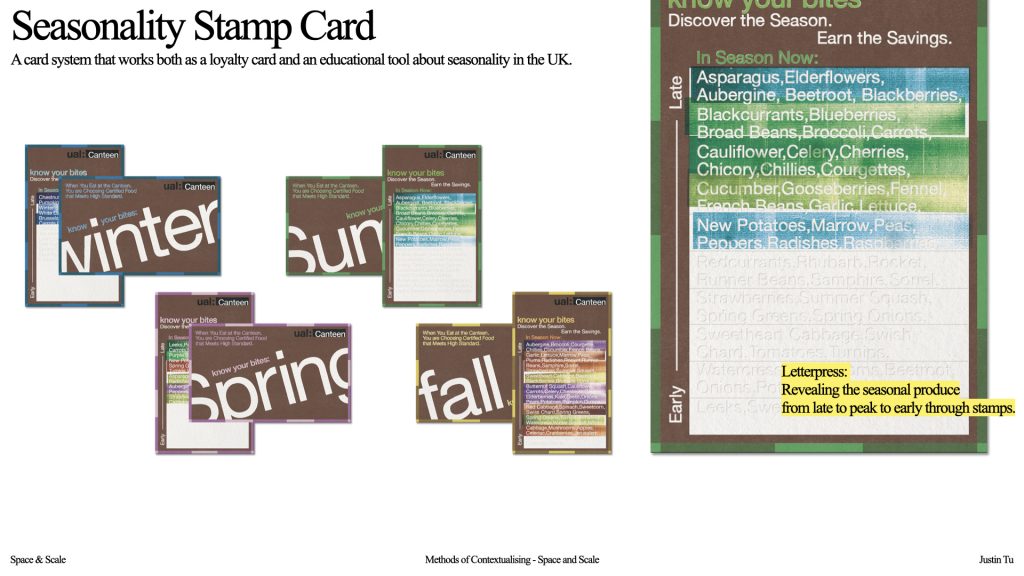
To make this information engaging rather than instructional, we introduced an element of playfulness through a card system that works both as a loyalty card and an educational tool about seasonality.
Each meal earns you a stamp, and after ten meals you receive a reward, along with access to the seasonal information hidden on the card. The card is valid for one season, after which you receive a new one that reflects the next cycle of produce.
The card contains information about seasonal produce which are embossed into the paper, in the order from late to early. The catch is that to read it, you have to reveal it with ink. And to get that ink, you need to eat in the canteen.
Building on this idea, we also designed a digital version of the card that can be added to your phone wallet. Each time you eat, you scan your meal, and its carbon footprint is added to a gradient bar. Each colour represents a different emissions category like our menu, turning it into a visual record of your personal food footprint, like a constant, gentle reminder of your impact.
With this system implemented across the canteen, we hope to support students in transitioning from ethical caring to in-practice caring, not just caring in principle but caring through everyday decisions. Ultimately, we hope this doesn’t just stay within the canteen. We want students to gain knowledge they can take home, share with others, and apply in their daily lives.
Through copying and analysing motion-based works in After Effects, I began to reconsider my previous understanding of time in relation to making. In the past, I associated time primarily with labour: the longer I spent on a work, the more refined it could become. However, working with animation software shifted this perception. Time no longer functioned only as a measure of production, but as an active compositional structure within the work itself.
Compared to my previous understanding of two-dimensional composition, constructed through points, lines and planes, After Effects introduces time as an additional dimension through which spatial depth is produced, rather than modelled. A single change at one moment in time can transform the entire trajectory of the image. This raises critical questions: how can time operate as a material within composition rather than merely a duration of making? In what ways does temporal control reshape ideas of space and visual rhythm?
To explore these questions, I propose a studio-based experiment in which I animate the same set of graphic elements under different temporal conditions. By keeping spatial composition constant while altering timing, easing and sequencing, I aim to observe how time alone restructures narrative and spatial depth. This experiment will allow me to explore time as an active paintbrush, shaping the composition through duration rather than spatial arrangement.
[Draft2]
After an initial stage of experimentation with After Effects, I became interested in how keyframes govern the majority of actions within the software, and how the intervals I set between them perform much of the work. This led me to reconsider the relationship between time and visual form: Could it operate as a compositional material that translates directly into the artwork? In response to this question, I began to experiment with “hacking” the Timeline Panel, treating it not as a back-end control interface but as a primary site of composition.
However, through this process, it became clear that within After Effects’ operational logic, time itself cannot exist independently of spatial attributes. Keyframes can only regulate the speed or rhythm of transformation between predefined parameters; they cannot autonomously determine where an object moves from or to, nor what shape it becomes. This limitation clarified the role of time within the software: rather than replacing spatial composition, time functions as a relational compositional mechanism, responsible for organising the order, rhythm, and overlap of events.
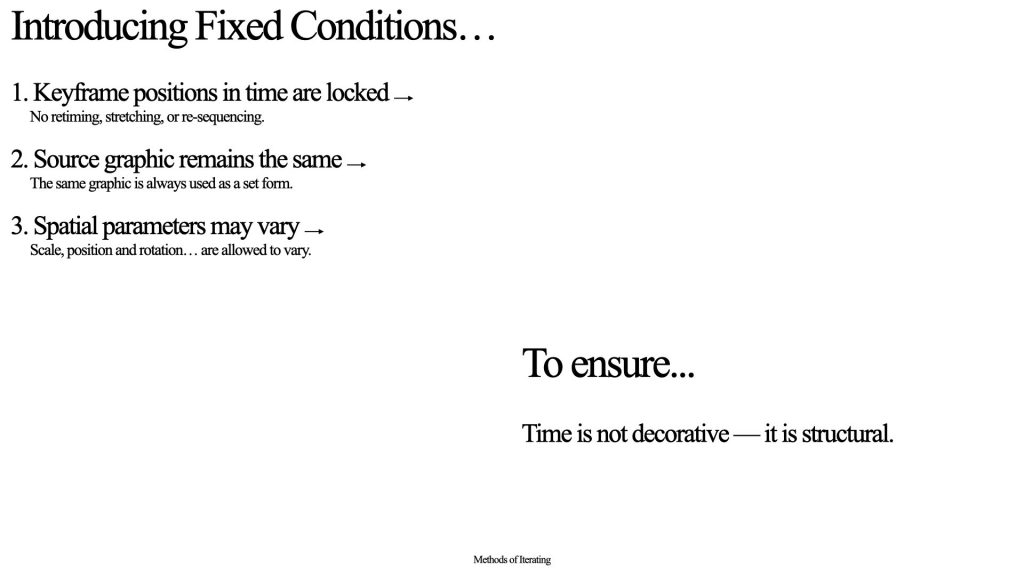
Against this backdrop, I began to use the Conditional Design Manifesto as a methodological lens through which to analyse and advance my enquiry (Maurer et al., 2013). The manifesto emphasises conditions over outcomes, systems over singular forms, and process as something that can be repeatedly executed while producing difference. Rather than attempting to make time directly determine spatial placement, I instead designed a set of experimental conditions that allowed time to intervene in the organisation of graphic relationships.
By keeping the temporal structure consistent while allowing spatial parameters such as scale and position to vary, the same time-based conditions generated multiple visual outcomes. Spatial relationships adapted in response to a fixed temporal framework. In this system, time does not replace spatial composition, but operates as a structuring constraint that governs how spatial elements relate to one another.
By adopting Conditional Design as a methodological framework and working within the constraints of After Effects, the focus shifts from producing a fixed visual result to designing conditions that allow differences to emerge. Rather than resolving the question of time as a compositional material, this process positions graphic communication as something that can unfold, adapt, and remain contingent, existing not as a final image, but as a system negotiating the relationship between time, structure, and visual form.
Reference: • Maurer, L., Puckey, J., Wouters, R. and Paulus, E. (2013) Conditional Design Manifesto. Amsterdam: Conditional Design.
[Draft3]
This reading is structured in layers, allowing the text to be accessed at different levels of depth. The full text presents the complete conceptual argument, while selected excerpts distil its core ideas into shorter versions for quicker engagement.
Reference: • Kubler, G. (1962) The Shape of Time: Remarks on the History of Things. New Haven: Yale University Press.
I have long been drawn to abstract visualisers, from the iTunes and PlayStation visualisers I watched as a child to contemporary loopy animations that create atmosphere rather than narrative. There was something hypnotic in simply watching forms respond over time. To begin this project, I decided to remake an animation that provides a visual presence to linger with the viewer.
week1
From this starting point, the artwork I chose to replicate is this animation by Julia Schimautz, whose work focuses on animation incorporated with Riso printing techniques. It creates a warm feeling and texture that gives a nostalgic touch.
I started analysing the artwork and trying to understand how she creates her work. At first, I thought it was created by making a few graphic elements and naively assumed that After Effects would do all the magic and create all the in-between transitions. But that was not the case.
After doing more research on her process, I realised that she first designs the animation, then exports it into frames and prints them through Riso. This creates the unique Riso effect, and then the frames are brought back into After Effects or Photoshop to make a stop-motion animation.
After understanding this process, and by following the brief, I decided to try replicating the artwork using one program throughout. This is where my own process began.
In my first attempt, I created an animated bar using a masking method, where the reveal of colour depended on how the mask opened and closed. I then duplicated this bar into 11 of them and rescaled it. After this, I applied effects to simulate a Riso texture. However, with this approach I could not control the starting point of the gradient, and after adding the halftone effect the colour disappeared completely.
In the second attempt, I used a different method to construct the bars. I created a central block and expanded it outward, adding the gradient directly onto each block. I then tested an alternative way of simulating the Riso effect, which allowed the colour to remain visible. During this attempt, I noticed that each bar was moving at a slightly different speed, rather than only changing in colour. At this point, I decided to let this problem remain unresolved and return to it in the next iteration. Despite this improvement, I still struggled to achieve the desired gradient and texture.
In the third attempt, I revised both the gradient construction and the expansion method. More importantly, I introduced more additional stop points to better control the movement, allowing each bar to have slightly different starting and ending points. This resolved many of the motion issues. However, the Riso effect continued to disrupt the preset, causing a loss of detail in both the gradients and textures.
In terms of movement, I feel I am gradually approaching the intended rhythm and overall motion of the artwork. However, replicating the Riso texture digitally remains challenging.
Through copying and analysing motion-based works in After Effects, I began to rethink how I understand time in making. Before, I mainly saw time as labour — the longer I spent on a work, the more refined it became. Working with animation changed this. Time is no longer only a measure of production, but becomes an active compositional element.
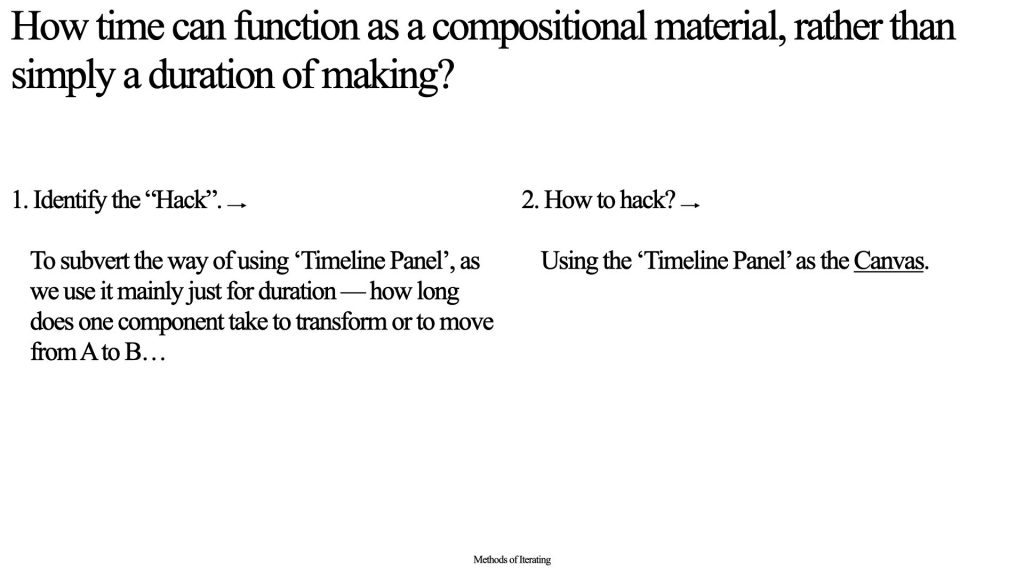
Compared to my previous understanding of two-dimensional composition, constructed through points, lines and planes, I realised that After Effects introduces time as an additional dimension. Small changes at a single moment can reshape the entire movement of an image. This led me to ask:
How time can function as a compositional material, rather than simply a duration of making?
week2
Building on what I mentioned last week, while exploring After Effects I realised that it introduces time as an additional dimension. Small changes at a single moment can reshape the entire movement of an image. When time became an active part of the composition, I began to question how it could be deliberately shaped and structured, rather than simply experienced as duration.
With this in mind, I began to consider what could be played with within the software itself.
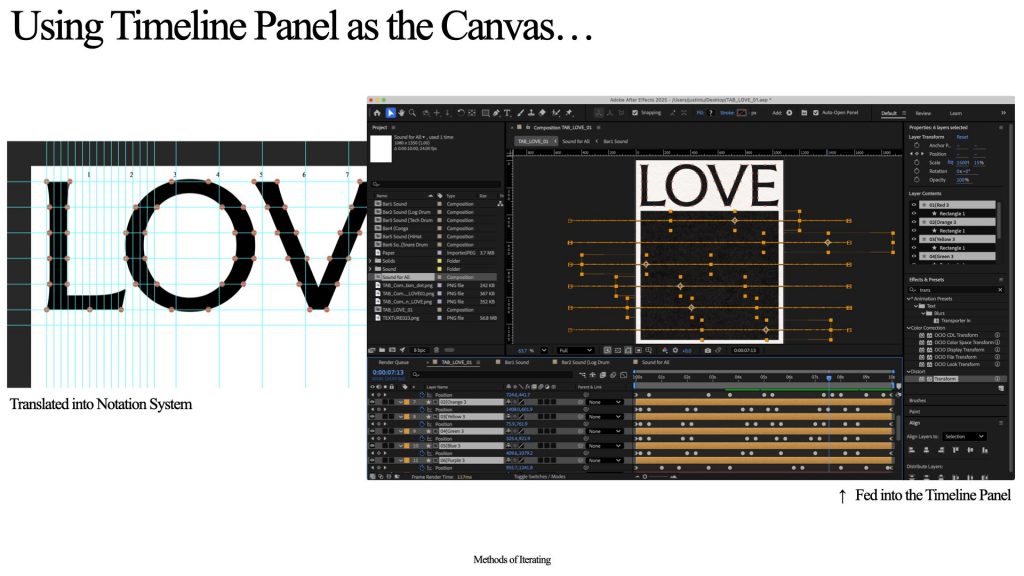
1. This led me to the idea of hacking the Timeline Panel, where keyframes are usually organised and used to control duration. 2. How? Instead of treating the Timeline Panel as a purely functional control, I began to think of it as a canvas. If the timeline itself becomes the site of creation, what kind of artwork does that produce, and what does it mean?
The graphic I drew into the panel was the word “LOVE” — a bit cheesy, I know. I used a grid to map the points where the letters intersected, then translated those points into the timeline so they could drive the animation from the back end.
Through this process, I realised that in After Effects, time cannot exist on its own; it always relies on spatial information. While keyframes can control rhythm and speed, they cannot determine where something moves or what form it takes. This clarified the role of time for me: rather than replacing spatial composition, time organises relationships such as order, rhythm, and overlap.
I began the project with a more whimsical enquiry: whether time could be treated as a compositional material in itself, shaped in the same way as form, colour, or space. However, experimentation made it clear that time cannot function independently unless embedded within a rule-based or preprogrammed system.
Returning to the readings, I turned to the Conditional Design Manifesto to push the project forward. This shift redirected my focus away from fixed outcomes and towards systems and conditions. Rather than forcing time to determine spatial form, I began setting up conditions in which time could intervene more indirectly.
From this position, I began testing how time could affect composition by constraining the ways elements interact with one another. Instead of determining spatial form directly, time operates at the level of conditions, shaping when and how compositional relations can occur. Composition is no longer a stable visual state, but a temporally negotiated condition.
Time cannot be a compositional material, but it can function as a compositional authority…
In these further iterative experiments, visible differences in motion and rhythm emerged; however, time was present only in prompting elements to react to one another and had not yet fully exerted control over compositional possibility.
week3
This led to a second approach: rather than allowing time to organise change, I began using time to deny compositional completion altogether. If composition is understood not as an image, but as a set of conditions that allow elements to coexist simultaneously, then time’s intervention is not to create variation, but to restrict simultaneity.
When time governs the conditions of visibility, composition shifts from spatial arrangement to temporal negotiation…
Under this framework, different elements appear at different moments—sometimes overlapping, sometimes delayed—but at no point are they present together. As a result, the composition cannot be held as a complete whole; it only exists as fragments distributed across time.
In developing this approach, I was drawn to broader reflections on how time is structured and understood. In The Shape of Time, George Kubler challenges linear, biologically modelled narratives of history, proposing that time operates through relational sequences rather than continuous progression(Kubler, 1962). This framework reinforced the idea that time actively structures the emergence and disappearance of form, rather than merely containing it.
This perspective also resonates with certain Eastern philosophical understandings of time, which emphasise cyclicality, intuition, and momentary awareness rather than linear accumulation. The Chinese phrase “花開花落自有時 huā kāi huā luò zì yǒu shí” (flowers bloom and fall in their own time) encapsulates this view: time is not a consumable resource, but a recurring condition through which existence unfolds.
This idea informed the visual poster developed from the experiments, where composition is never fixed, never fully revealed, and always contingent on temporal flow.
Moving forward, I’m interested in how this approach to composition, where elements are fragmented across time and never fully co-present, could open up further possibilities beyond formal exploration. By distributing composition rather than resolving it, the work creates space for meaning to emerge through absence and delay. I’m curious how this method could be extended to contexts where visibility is restricted, and where what cannot be shown becomes as significant as what appears.