[critical analysis]
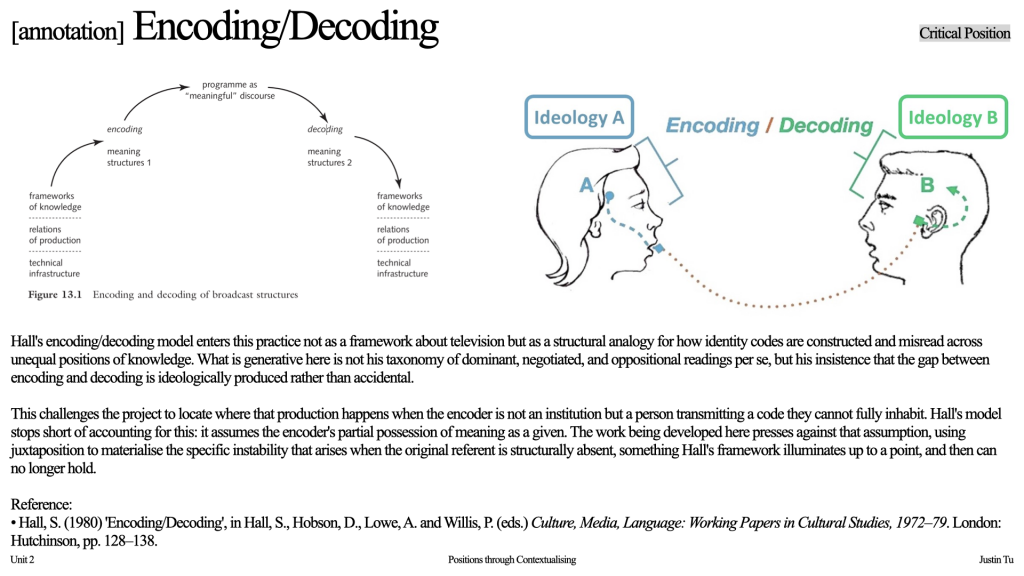
Stuart Hall’s Encoding/Decoding (1980) challenges the assumption that communication transmits meaning transparently from sender to receiver. Hall argues that media texts are encoded with preferred meanings shaped by dominant cultural and ideological frameworks, but that audiences decode these messages through their own social positions, producing dominant, negotiated, or oppositional readings. Meaning, for Hall, is never fixed but always contested in the gap between encoding and decoding.
This framework becomes unexpectedly generative when applied beyond broadcast media to more intimate circuits of transmission. In my own practice, the “text” being encoded and decoded is not a television programme but masculinity itself, a set of codes, behaviours, and expectations passed from mother to child in the absence of a father. Here the encoder is not a media institution but a woman translating a gender she does not inhabit, shaping a preferred meaning of manhood from the outside. The decoder, the child, receives this transmission and negotiates it not against institutional ideology but against the lived reality of who is actually present, who is actually looked up to. The result is neither a clean dominant reading nor a straightforwardly oppositional one: it is a negotiated, approximate, and deeply personal decoding of what it means to be a man, assembled from instructions that were always secondhand.
Hall’s model, even in its most nuanced form, depends on one underlying assumption: that the encoder possesses, at least partially, the code they are transmitting. Institutional authority derives from this possession, the broadcaster knows the preferred meaning of the national interest, even if the audience resists it. But in the circuit this project describes, that possession is structurally impossible. The original referent, the father, masculinity as directly inhabited experience, is absent from both ends of the transmission. The encoder cannot possess what was never fully present to her. The decoder cannot verify what he receives against any original. There is no source to return to. This is not a failure of communication in Hall’s sense, not a misalignment between meaning structures 1 and 2 that could in principle be corrected. It is a condition in which the original encoding never existed in a stable form. What circulates instead is a construction that presents itself as a transmission, a preferred meaning of masculinity assembled from approximation, desire, and absence, passed on with the confidence of someone who believes they are relaying something real. The distortion is not in the gap between sender and receiver. It is built into the message from the beginning.
Formally, this theoretical understanding shapes the logic of juxtaposition in the work. The project places found imagery from magazines and instructional print media, confident and authoritative encodings of what a man should look like, how he should behave, what he should provide alongside images drawn from the domestic and the habitual: objects, gestures, and traces of the life that was actually being lived. These are not paired as simple opposites, false masculinity against real warmth. The pairings are more uncomfortable than that. They recreate the condition of receiving a fractured transmission: the official instruction sitting next to quiet evidence that the life surrounding it told a different story.
This is the experience Hall’s framework describes but cannot fully recreate analytically. The gap between meaning structures 1 and 2, between what was encoded and what was decoded, becomes something the viewer stands inside rather than reads about. The juxtaposition does not illustrate a contradictory transmission. It enacts one. The viewer feels the instability before they can name it, which is precisely the condition of a child assembling identity from instructions that were never internally consistent to begin with.
[critical analysis]
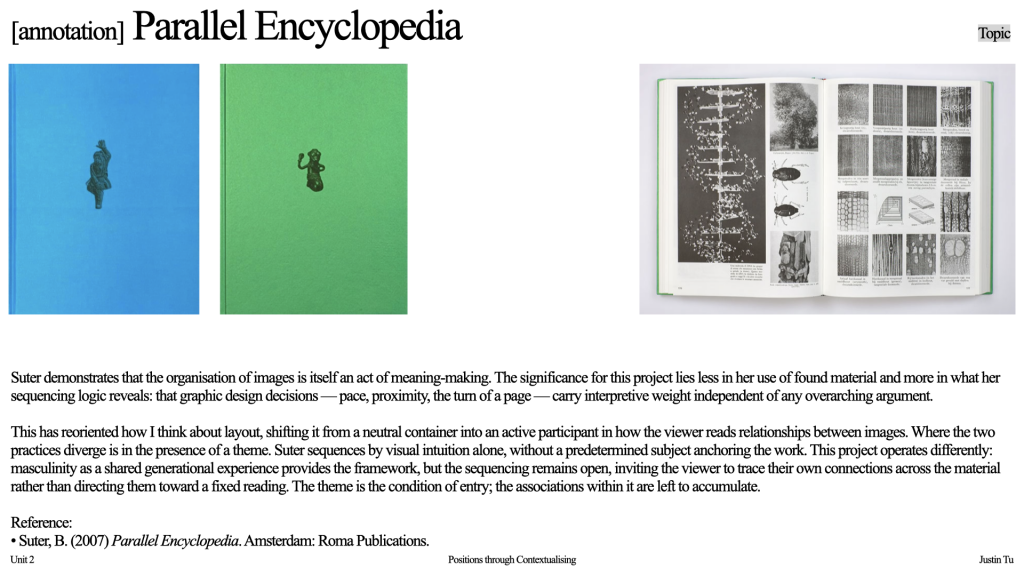
Batia Suter’s Parallel Encyclopedia (2007) is an artist’s book composed of found images sourced from vintage encyclopedias, spanning subjects such as science, nature, anatomy, and architecture. Removed from their original captions and reordered into a non-linear sequence, the images form unexpected visual associations that disrupt their initial classificatory function. Through juxtaposition and sequencing, Suter collapses distinctions between disciplinary categories, encouraging viewers to read images through resemblance, rhythm, and visual intuition rather than through scientific taxonomy. The absence of explanatory text destabilises the authority typically associated with encyclopedic systems of knowledge, transforming the publication from a didactic reference tool into an open-ended visual field.
The formal qualities of the book are central to this process. The sequencing of full-page images across spreads creates connections between otherwise unrelated subjects, allowing meaning to emerge relationally rather than hierarchically. For example, microscopic organic forms may visually echo architectural structures or mechanical systems, producing associations that blur boundaries between the natural and constructed world. In this sense, Suter uses editorial design not to clarify information, but to complicate and destabilise it. The work challenges the conventional role of graphic and communication design as a tool for order, legibility, and categorisation, rather than functioning as a neutral support system for pre-existing information, graphic design in Parallel Encyclopedia becomes a generative mechanism through which meaning is actively produced.
Although Suter’s process appears intuitive rather than overtly political, the work implicitly critiques encyclopedic authority by dismantling systems of classification and linear organisation. However, the project’s emphasis on visual openness also reveals certain limitations. While Parallel Encyclopedia encourages associative interpretation, Stuart Hall’s theory of encoding and decoding suggests that viewers never approach images from neutral positions; meaning is always shaped through culturally situated processes of interpretation. bell hooks extends this critique by arguing that spectatorship is further structured by power relations, particularly through race, gender, and histories of representation. Together, these perspectives complicate the apparent openness of Suter’s work, revealing that visual interpretation is never entirely free from ideology or social conditioning.
This tension between openness and conditioned spectatorship is particularly relevant to my own project. While I am interested in Suter’s use of archival imagery, fragmentation, and associative sequencing, I also want to critically examine how meaning is shaped by culturally embedded assumptions and structures of power. Rather than treating interpretation as unlimited, my project explores how viewers project ideological and emotional frameworks onto visual material. In this way, Suter’s work has influenced my understanding of graphic design not simply as a neutral system of communication, but as a medium that actively constructs relationships between knowledge, perception, and interpretation.
Leave a Reply