Introduction
I have long been drawn to abstract visualisers, from the iTunes and PlayStation visualisers I watched as a child to contemporary loopy animations that create atmosphere rather than narrative. There was something hypnotic in simply watching forms respond over time. To begin this project, I decided to remake an animation that provides a visual presence to linger with the viewer.
week1
From this starting point, the artwork I chose to replicate is this animation by Julia Schimautz, whose work focuses on animation incorporated with Riso printing techniques. It creates a warm feeling and texture that gives a nostalgic touch.
I started analysing the artwork and trying to understand how she creates her work. At first, I thought it was created by making a few graphic elements and naively assumed that After Effects would do all the magic and create all the in-between transitions. But that was not the case.
After doing more research on her process, I realised that she first designs the animation, then exports it into frames and prints them through Riso. This creates the unique Riso effect, and then the frames are brought back into After Effects or Photoshop to make a stop-motion animation.
After understanding this process, and by following the brief, I decided to try replicating the artwork using one program throughout. This is where my own process began.
In my first attempt, I created an animated bar using a masking method, where the reveal of colour depended on how the mask opened and closed. I then duplicated this bar into 11 of them and rescaled it. After this, I applied effects to simulate a Riso texture. However, with this approach I could not control the starting point of the gradient, and after adding the halftone effect the colour disappeared completely.
In the second attempt, I used a different method to construct the bars. I created a central block and expanded it outward, adding the gradient directly onto each block. I then tested an alternative way of simulating the Riso effect, which allowed the colour to remain visible. During this attempt, I noticed that each bar was moving at a slightly different speed, rather than only changing in colour. At this point, I decided to let this problem remain unresolved and return to it in the next iteration. Despite this improvement, I still struggled to achieve the desired gradient and texture.
In the third attempt, I revised both the gradient construction and the expansion method. More importantly, I introduced more additional stop points to better control the movement, allowing each bar to have slightly different starting and ending points. This resolved many of the motion issues. However, the Riso effect continued to disrupt the preset, causing a loss of detail in both the gradients and textures.
In terms of movement, I feel I am gradually approaching the intended rhythm and overall motion of the artwork. However, replicating the Riso texture digitally remains challenging.
Through copying and analysing motion-based works in After Effects, I began to rethink how I understand time in making. Before, I mainly saw time as labour — the longer I spent on a work, the more refined it became. Working with animation changed this. Time is no longer only a measure of production, but becomes an active compositional element.
Compared to my previous understanding of two-dimensional composition, constructed through points, lines and planes, I realised that After Effects introduces time as an additional dimension. Small changes at a single moment can reshape the entire movement of an image. This led me to ask:
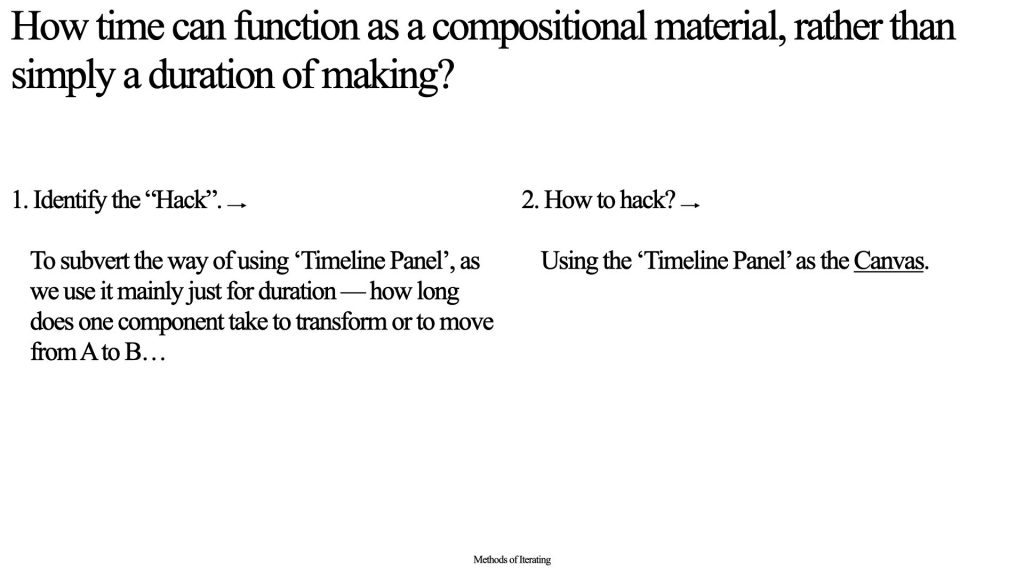
How time can function as a compositional material, rather than simply a duration of making?
week2
Building on what I mentioned last week, while exploring After Effects I realised that it introduces time as an additional dimension. Small changes at a single moment can reshape the entire movement of an image. When time became an active part of the composition, I began to question how it could be deliberately shaped and structured, rather than simply experienced as duration.
With this in mind, I began to consider what could be played with within the software itself.
1. This led me to the idea of hacking the Timeline Panel, where keyframes are usually organised and used to control duration.
2. How? Instead of treating the Timeline Panel as a purely functional control, I began to think of it as a canvas. If the timeline itself becomes the site of creation, what kind of artwork does that produce, and what does it mean?
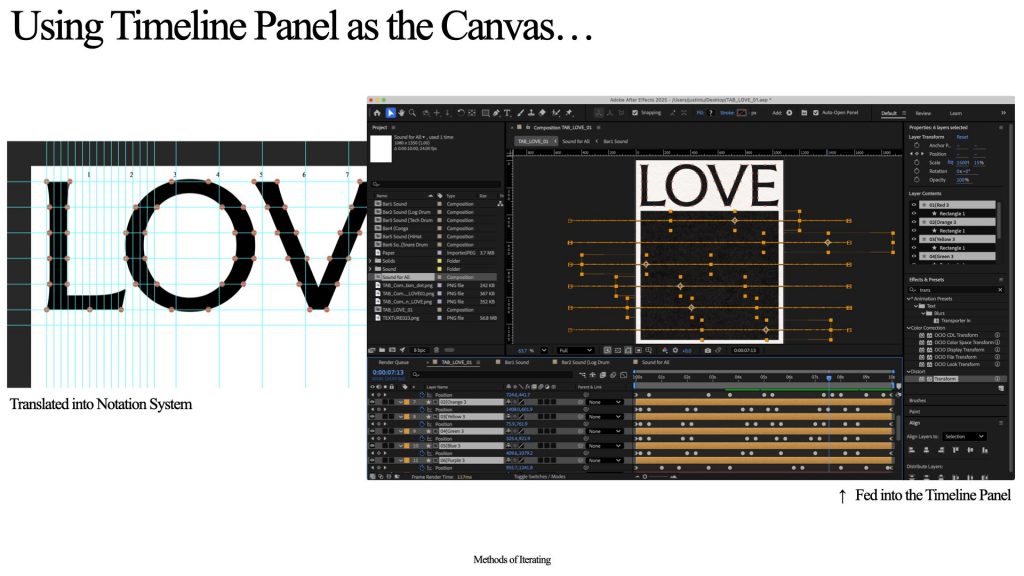
The graphic I drew into the panel was the word “LOVE” — a bit cheesy, I know. I used a grid to map the points where the letters intersected, then translated those points into the timeline so they could drive the animation from the back end.
Through this process, I realised that in After Effects, time cannot exist on its own; it always relies on spatial information. While keyframes can control rhythm and speed, they cannot determine where something moves or what form it takes. This clarified the role of time for me: rather than replacing spatial composition, time organises relationships such as order, rhythm, and overlap.
I began the project with a more whimsical enquiry: whether time could be treated as a compositional material in itself, shaped in the same way as form, colour, or space. However, experimentation made it clear that time cannot function independently unless embedded within a rule-based or preprogrammed system.
Returning to the readings, I turned to the Conditional Design Manifesto to push the project forward. This shift redirected my focus away from fixed outcomes and towards systems and conditions. Rather than forcing time to determine spatial form, I began setting up conditions in which time could intervene more indirectly.
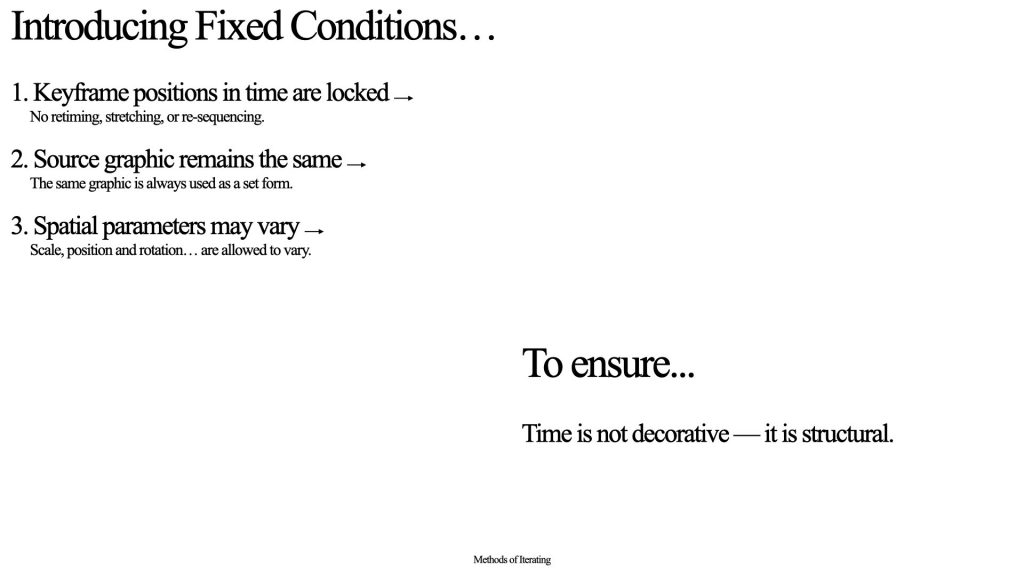
From this position, I began testing how time could affect composition by constraining the ways elements interact with one another. Instead of determining spatial form directly, time operates at the level of conditions, shaping when and how compositional relations can occur. Composition is no longer a stable visual state, but a temporally negotiated condition.
Time cannot be a compositional material, but it can function as a compositional authority…
In these further iterative experiments, visible differences in motion and rhythm emerged; however, time was present only in prompting elements to react to one another and had not yet fully exerted control over compositional possibility.
week3
This led to a second approach: rather than allowing time to organise change, I began using time to deny compositional completion altogether. If composition is understood not as an image, but as a set of conditions that allow elements to coexist simultaneously, then time’s intervention is not to create variation, but to restrict simultaneity.
When time governs the conditions of visibility, composition shifts from spatial arrangement to temporal negotiation…
Under this framework, different elements appear at different moments—sometimes overlapping, sometimes delayed—but at no point are they present together. As a result, the composition cannot be held as a complete whole; it only exists as fragments distributed across time.
In developing this approach, I was drawn to broader reflections on how time is structured and understood. In The Shape of Time, George Kubler challenges linear, biologically modelled narratives of history, proposing that time operates through relational sequences rather than continuous progression(Kubler, 1962). This framework reinforced the idea that time actively structures the emergence and disappearance of form, rather than merely containing it.
This perspective also resonates with certain Eastern philosophical understandings of time, which emphasise cyclicality, intuition, and momentary awareness rather than linear accumulation. The Chinese phrase “花開花落自有時 huā kāi huā luò zì yǒu shí” (flowers bloom and fall in their own time) encapsulates this view: time is not a consumable resource, but a recurring condition through which existence unfolds.
This idea informed the visual poster developed from the experiments, where composition is never fixed, never fully revealed, and always contingent on temporal flow.
Moving forward, I’m interested in how this approach to composition, where elements are fragmented across time and never fully co-present, could open up further possibilities beyond formal exploration. By distributing composition rather than resolving it, the work creates space for meaning to emerge through absence and delay. I’m curious how this method could be extended to contexts where visibility is restricted, and where what cannot be shown becomes as significant as what appears.
Leave a Reply